Tuesday, January 17, 2012

ATTENTION GOSSIP HOUNDS! PHOTOPLAY - JANUARY 1931

Oh, to be a movie fan in January 1931! I admit it - I love Hollywood gossip. It would be nice to say I'm above all that and I love the movies for their artistic merit, but I'm not. I love the dish, the dirt, the spectacle, the drama and those little, juicy tidbits about how the west coast glamorous set lived (and lives). Admittedly, today's celebrity gossip runs to trash, but, boy, back in the "golden age," if you plunked down 25 cents for a Photoplay Magazine, you sure got a lot for your money and your dreams.
The movie magazine and gossip industry, an arm of the studios, was running on all 12 cylinders back then. Just look at this gorgeous cover of Clara Bow! The cover art of Photoplay and other movie publications were works of art in themselves.

This particular issue is interesting because, in 1931, the silent stars were still a force in Hollywood, but were swiftly being overtaken in the hearts of the fans by those upstart talkie stars. May I take you on a little tour of this issue?

First Stop: Letters to the Editor (called "Brickbats & Bouquets")
Touting the philosophy that "you fans are the real critics," Photoplay gave $25, $10 and $5 for the best letters. However, they caution that "just plain spiteful letters won't be printed." How refreshing.

Here are the winning letters:
For $5: "There is too much talk in the talkies." W. Dolen
For $10: "What is wrong with the fans, always complaining about the talkies? The talkies are only three years old and they're improving all the time. Prohibition is thirteen years old and it hasn't improved a particle. Think it over." - Catherine Finn
For the top prize of $25: "To whomever is concerned with censorship, I beg to suggest that it is the press that needs constraint, and not the pictures. Our American audiences are essentially the only censors needed as far as morals are concerned. They respond consistently to the best and most worthy productions. Not even lurid box-office titles can do much for vulgar or insipid pictures.
   Newspapers, however, delight to frontpage any unfortunate sequence in the life of any movie star - the brighter, the quicker! Daily instances of generosity, loyalty, and decency among the movie colony are passed up by the yellow sheet. But let some actor who has worked hard and won a place in popular favor make one error in judgment and it is hot news. We can always 'see by the papers.'
   Let us judge men and women of the screen by their performance on the screen and not by their private lives." - E.D. Russell

Some things never change, do they?

Next Stop: Brief Reviews of Current Pictures
Each month Photoplay gave a 2 or 3 line review of the films currently paying at local theaters. In January 1931, movie goers had 231 choices! Isn't that amazing? Some of Photoplay's top picks for January 1931 were Abraham Lincoln (Directed by D.W. Griffith), Feet First (Harold Lloyd), Floradora Girl (Marion Davies), Holiday (Ann Harding), Laughter (Nancy Carroll, Fredric March), Morocco (Marlene Dietrich, Gary Cooper), Our Bushing Brides (Joan Crawford), Raffles (Ronald Colman), Just Imagine (life in 1980!) and Romance (Greta Garbo). An intriguing combination of silent and sound stars.

Some of the films that got good reviews but did not make Photplay's preferred list were: Animal Crackers, Little Caesar, Redemption ("John Gilbert's  first talkie, made before His Glorious Night, but shelved and now largely remade. A tragic story by Tolstoi proves John can act") and Hell's Angels ("Three years and $4,000,000 were invested in this. Worth seeing, but $4,000,000 worth?").

Most films were praised, very few outright panned. After all, the magazines were a cog in the wheel of the movie industry.

Next Up: Gorgeous Portraits
Wonder where all of those gorgeous portraits of the stars ended up? Mainly in the movie magazines. These artful photos helped the public worship a star in all their beauty and style. Photoplay's January 1931 issue gave the public full page portraits of Marilyn Miller, Dorothy Jordan, Constance Bennett, Adolphe Menju, and Claudette Colbert.

Gossip! Gossip! Gossip!
Charles Farrel and Virginia Valli to marry! Francis X. Bushman is flat broke! (but, oh, he had a swell time!), 42 weeks of hard labor in vaudeville changes Esther Ralston from a little blonde ingenue to a pungent personality and a sure-footed star! Gloria Swanson's ex-husband, the Marquis de la Falaise, heads straight for Connie Bennett! Pola Negri threatens to "tell all" in her memoirs! Mary Pickford's miniature golf course was robbed (of $75)! William Powell and Carole Lombard are "that way" about each other!  Greta Garbo seen on the M-G-M lot wearing a pair of dark blue sailor trousers, a little blue jacket and a white sailor hat! Walter Houston and Gilda Gray have been seen dining and dancing places together! Joan Crawford and hubby Douglas Fairbanks, Jr. sell their home, "El Jodo."

Kay Francis and her latest Fashions! (photos by Hurrell)

Here are a few of my favorite tidbits:
"I believe that future ages will resurrect Chaplin's tattered comedies and study them as reverently as they now study Italian primitives. He will be spoken of as people now speak of Grimaldi, only his fame will be greater than Grimaldi's because the film audience is universal" - Frederick Lonsdasle, English playwright. Bingo!

From James R. Quirk's column: "Clara Bow doesn't seem to have any more luck with her secretaries than some big business men. The first one married Clara's pappy, and the second one is yelling Clara ain't done right by her. The days after secretarial rumpus number two started in the newspapers, Clara received an application for the position. It read: 'I am a capable stenographer, intelligent and refined, but am now working as a librarian. This work is dull and sedentary and I would like a change.' Young lady, I am no fortune teller, but I can tell you that if you get the job, you are going to get your wish." January 1931 was the beginning of the Daisy Devoe trial and the end of Clara Bow's career.

And buried on page 43: "The Academy of Motion Picture Arts and Sciences has made its annual awards for the best pictures work done in the year ending in July. They are:
The Best Picture - All Quiet on the Western Front
The Best Director - Lewis Milestone, who made all Quiet on the Western Front
Best Actor - George Arliss, for Disraeli
Best Actress - Norma Shearer for The Divorcee
Best Screenwriting - Frances Marion for The Big House
Best Art Direction - King of Jazz
Best Photography - the two boys who sent into the Antarctic with Admiral Byrd

All the winners get little statues as their visible prizes. But what publicity!" What??? No Red Carpet???? 

Meat and Potatoes: Feature Articles
"Willy to his Mother" - all about William Powell's ma an pa, how they run his finances and fetch his orange juice!
Paging Nora Charles!

"Mary Pickford Denies All!" America's Es-Sweetheart smacks down reports that she's to divorce Doug, retire or go on the stage.
Of course, Mary and Doug did divorce, she did try a stage play and she did retire. Oh well!

"Hell's Angel" Aged psychoanalyst now focuses his inspired spyglass on Jean Harlow.
Her hair and her body are arousing, but she's also "forthright, earnest, sincere and handy with her dukes." We knew that!

"Chatterton and Barrymore Lead the Screen in 1930." 
1930's most popular stars based upon their performances. Barrymore and Chatteron lead the pack. Lewis Stone and Beryl Mercer bring up the rear.

"John Boles Confesses" Universal's Great Lover discloses the technique of amour that made him famous on the screen.
(it has something to do with Einstein's theory).

"By Time and Tears" Not sorrow alone, but growth of mind and spirit, gave Mary Astor the rich womanliness that is hers today.
Mary's success on the stage (after Hollywood thought she wouldn't make it in talkies) and the death of her husband made her a woman.

"'Quit Pickin' on Me!' Says Clara Bow" It seems the public and the fan mags just couldn't stop picking on Clara.
While filming No Limit, Clara is taken to task for her gambling troubles, past loves and even her weight. Amazingly, she is described as "pathetic."

The fact that this article felt free to be unkind to Clara surely signaled Paramount's (and Hollywood's) decision to wash their hands of her, although she remained popular with the public. It would only be a short time before Clara Bow left Hollywood for good.

Last Stop: Advertisements
And just in case you needed to know these things:
k Lucky Strike cigarettes are toasted.
k Ipana toothpaste will get rid of bleeding gums.
k In all the world, there is no cigarette so fragrant, so delicate, so delightful as Camel.
k English and American beauties entrust their flower-like skin to Ponds.
k Lux Toilet Soap is the complexion secret of 98% of the stars (and it only costs 10 cents).
k Sal Hepatica saline treatment gives a gal a radiant bloom on her cheeks. Saline treatment = laxative, by the way.
k Nerves? don't use pills - send 25 cents for a book that teaches you how to gain confidence, vigor and calmness!
kkk and, my favorite: The Anita Nose Adjuster
I'm sending for one!!!!

Sorry, but in the interest of space I left out quite a few features and tidbits, not to mention film reviews and glorious photos. Oh to be a movie fan in January 1931! Wasn't that fun?


Tuesday, January 10, 2012

MOVIE BOOKS I LOVE: A SONG IN THE DARK: THE BIRTH OF THE MUSICAL FILM by Richard Barrios

This is an occasional series featuring my favorite movie books. Before TCM and the internet, the only way to satisfy my passion to know more about Classic Hollywood was through books, books and more books. I've cleared away the clutter over the years, but many remain permanent residents in my home. You'd never throw out an old friend, now, would you?
This is another book in my library that is so worn by repeated readings and look-ups that I am ashamed to loan it out to anyone. It covers one of the eras of Hollywood cinema that I love the best - that of the very early movie musicals.

For those who think a Fred Astaire and Ginger Rogers musical is an example of an early movie musical, this book will be a revelation. Richard Barrios takes us, in a totally entertaining manner, on a well researched journey from the earliest days of sound to the first musical classics. It's a compelling tale of trial and error, great triumphs for some and painful heartbreak and failure for others. This is the real story of the era of Singing in the Rain, and, as if often the case, truth is more interesting than fiction.

Early Sound
In 1925, the biggest star at the Warner Brothers Studio was Rin Tin Tin. That year the studio acquired the Vitaphone process, which recorded sound on disc. Vitaphone sound was introduced in 1926 as the musical soundtrack of the feature, Don Juan.
In addition to the feature film, Warners also presented a series of short sound films featuring mostly classical music and a short spoken message from Will Hayes.
Once Jolson and The Jazz Singer hit the theaters in 1927, there was no turning back, although the sound on disc method was quickly replaced by the sound on film process.

The Broadway Melody: 
All Talking! All Singing! All Dancing!
This is the movie that put it all together. Crude, with a creaky story even for 1929, The Broadway Melody was one of the very first true musical films. Released at  time when technology was rapidly enhancing the quality of talking pictures, it became the model for literally hundreds of successors and imitators. Seen today, it seems a dated antique, but Barrios breathes life back into the story of the film that won the 1929 Academy Award for Best Picture.

Hollywood Revues
A major craze of the era was the revue - a variety-show format where each studio showcased the musical talents of its contract players. The musical film was still viewed as a competitor with the stage musical, and not yet as something wholly unique. If Broadway could have The Ziegfeld Follies and The George White Scandals, Hollywood could have Paramount on Parade and MGM's Hollywood Revue of 1929. Some stars shined in the venue and some produced either a giggle, a moan or a cringe. Marion Davies, Ruth Chatterton and Joan Crawford did their best, but their musical limitations were exposed (although Davies did shine in the musical Marianne). Buster Keaton, on the other hand, surprised everyone with his totally appropriate baritone and dancing agility. Marie Dressler proved she could master any genre and Maurice Chevalier and Lillian Roth blew the competition away.

From Broadway to Hollywood
One of my favorite sections of this book is the story of how many Broadway performers were brought to Hollywood in the belief that their musical stage success would translate to film. In the typical trial and error method of the era, many great stage performances were captured on film. Ironically, the medium the stage performers looked down upon preserved many of their greatest achievements. Thanks to Hollywood we have the talents of musical theater greats like Marilyn Miller, Ann Pennington, Mary Eaton, Fanny Brice, Irene Bordoni, Ethel Waters, Paul Robeson, Helen Morgan and Charles King preserved on film. Most didn't make it in Hollywood and headed back to Broadway after one or two films. Some, like Al Jolson and Eddie Cantor, added movie stardom to their already impressive resumes. All left evidence of their artistry for the world to forever enjoy.

The Stars
As the era unfolded, it was clear that some performers were destined for greater stardom, while some saw their luster dimmed.
In - Stars Who Succeeded
Nancy Carroll and Buddy Rogers get musical
Stars like Nancy Carroll, John Boles, Bessie Love, Bebe Daniels, Buddy Rogers,  and Janet Gaynor saw their film careers escalate with their success in musical films. Opera stars like Lawrence Tibbett and Grace Moore enjoyed their moment in the cinema sun, and even Gloria Swanson surprised her critics when she proved she could sing (and even had a hit song, "Love, Your Magic Spell is Everywhere," from The Trespasser).

Out - Those Who Failed
Clara Bow (and Fredric March)
Established silent stars like Corinne Griffith and Mae Murray were not only defeated by sound, but failed in their musical attempts, as well. Clara Bow proved to have ability, but her fear of the microphone as well as her failing health sent her star into decline.

42nd Street and Beyond
It was only a matter of time before the winning formula was found and artists like Fred Astaire, Busby Berkely, Bing Crosby and Ginger Rogers transformed the Hollywood Movie Musical into the professional and polished product we know today. With Warner Brothers' 42nd Street and Paramount's Love Me Tonight, the genre was perfected. No longer the poor rival to the stage, the movie musical had found its identity. All of those early possibilities and promises blossomed into a bona fide art form.

As a story that lives the margins of a larger one (the arrival of sound), thein  saga of the early movie musicals is a wonderful and harrowing tale. Experimenting and learning as they went along, careers were made and lost. And, while the end product of this experimentation is a cherished art form, there is nothing so charming as the journey that gave us singers who sound like regular people, chorus girls who are not always in step and who sometimes look as though they need a Jenny Craig consultant, and Technicolor skies that were green instead of blue.

The research is impeccable (with tons of juicy behind-the-scenes gossip) and the writing delightful. Barrios writes as an enthusiastic lover of film rather than a stuffy scholar and I never, ever want to part with this book.


Some of My Favorite Early Musicals:
Ultra romantic John Boles and Bebe Daniels in Rio Rita
Sally (Marilyn Miller in all of her glory - 1929)
Follow Thru (Nancy Carroll and Buddy Rogers in a gold musical. They sing "we'd make a peach of a pair" and they sure do  -1930)
Rio Rita (John Boles and Bebe Daniels - romantic as hell - 1929)
Madam Satan (wild CB DeMille - 1930)


"A Song in the Dark" (1995) is available for a very wide range of prices at various sites, including Amazon.

Tuesday, January 3, 2012

Mary Astor (Bitch)/George Sanders (Blaggard)

This is the first in the "Bitches and Blaggards" series; monthly posts devoted to my favorite movie bad girls and rogues. A bitch is a selfish, malicious woman. A blaggard is a villain, a rogue and a black-hearted man. Both are bad, both are devastatingly alluring.

Mary Astor
Mary Astor is my favorite "movie bitch." Like a jagged shard of glass, she glitters, she shines, but she is hard and she can cut deep. As an actress, Mary Astor has few equals. Her first roles were of the Madonna type, but she soon found her niche playing ladies who were lethally lovely and never to be trusted.

Mary's two crowning "B" roles are Brigid O'Shaughnessy in "The Maltese Falcon" and Sandra Kovak in "The Great Lie."

Brigid O'Shaughnessy ("The Maltese Falcon")
Did you fall for Brigid's act the first time you saw this film? If you did, don't feel foolish, since a tough guy like Bogey's Sam Spade also fell hook, line and sinker. Her eyes are so moist, her voice trembles, she so needs the protection of a man like Sam Spade. How could he resist? Selfish, duplicitous, conniving, unrepentant and beautiful, she is the ultimate noir femme fatale. We really don't like her, but we can't take our eyes off of her, either.

Sandra Kovak ("The Great Lie")
This is Mary Astor's finest hour as the ultimate movie bitch. In "The Great Lie" Bette Davis (who can bitch with the best of them) steps aside and lets Astor steal the show. Davis' acting generosity to Mary Astor in this film is stunning. As the cold, selfish, brilliant pianist and party girl Sandra Kovak, Astor poaches George Brent's Pete from Bette's Maggie, impulsively marries him and manages to get pregnant by him before the two discover the marriage was not valid because Sandra's divorce from hubby #1 was not final. Pete, unaware of the pregnancy, feels he dodged a bullet, ditches Sandra and returns to true love Maggie before flying off into the unknown. Not wanting the child, Sandra willingly gives it to Maggie to raise before embarking on a successful world tour. Imagine the surprise of both gals when Pete returns home alive. He happily reunites with Maggie, who tells him that the child is theirs. Selfish Sandra decides she wants Pete for herself and holds the secret of the child's paternity over poor Maggie's head. Apparently, both natural mom and dad really don't want that kid, as Pete tells Sandra she can have the child, but he'll keep Maggie, thank you. Good thing Maggie wants the child, since Sandra doesn't want him without the father. Astor elevates screen acting to its highest art. She is amazing and was awarded 1941's Academy Award for the Best Supporting Actress.

Mary Astor had a long and varied career in Hollywood. She went from the perfect innocent in the 1920s, to the perfect sophisticate in the 1930s to the perfect bitch in the 1940s. She could be nice ("Dodsworth") and not so nice ("Red Dust"). Her playing was always delicate, incisive and refined.

Mary Astor's personal life proved to be even more dramatic than any film she ever made. Prodded into acting by oppressive parents who virtually held her a prisoner into her 20s, at age 18 she engaged in a passionate affair with the much older John Barrymore (until he ditched her for equally young Dolores Costello). She married four times, and, during a bitter child custody battle with husband #2, her private diary (which contained much purple prose and detailed a sexual affair with playwright George S. Kaufman) was exposed with much publicity. Later, she became disenchanted with Hollywood and struggled with alcoholism and several suicide attempts. She recovered and went on to write six novels, two autobiographies and kept her hand in acting on both stage and screen (her last appearance being in "Hush, Hush Sweet Charlotte" with friend Bette Davis).

George Sanders
Suave, elegant, deadly - ah the magic of George Sanders. Was there ever a man so sophisticated, so cynical, so seemingly morally corrupt - yet so attractive? I can't think of any.

I am sure George Sanders played some nice men, but it's hard to think of him as anything but a rogue. My two favorite George Sanders roguish roles are Jack Favell in "Rebecca" and Addison DeWitt in "All About Eve."


Jack Favell ("Rebecca")
Jack Favell is a blaggard, plain and simple. As Rebecca's disreputable cousin (and Mrs. Danvers' partner in psychological crime), Sanders is a charmer with a capital "C". Joan Fontaine knows he's bad, but he sure seems nice - and much more fun than stuffy Maxim De Winter. She doesn't close the door in his face, even though she knows she should, and neither would any of us because you just know he'd never, ever be a bore. And besides, he was right, wasn't he?


Addison DeWitt ("All About Eve")
Addison DeWitt is probably one of the best written and best performed characters in the history of film. That's a pretty strong statement, but I stand behind it. George Sanders is perfection as the acid-tongued theater critic who knows all the players and all the angles and who has Eve Harrington's number right from the start. Sardonic and suave, I can't imagine any other actor who could do justice to Addison DeWitt. With a love of self that cannot be trumped by any feminine wiles, he is the perfect dinner guest and the most deadly of enemies. For his brilliant work he was awarded the 1950 Academy Award for Best Supporting Actor.


The one Sanders role I long to see is his performance in "The Private Affairs of Bel Ami." As a rogue who climbs over a series of women to attain social prominence, it seems to be the ultimate George Sanders role (and Ann Dvorak is in it, too!). It is on VHS, but since my VCR melted long ago, I'll have to wait and hope it is either released on DVD or TCM decides to show it.


George Sanders' career lasted into the 1970s. Not only was he Hollywood's premier rogue ("The Ghost and Mrs. Muir" and "The Picture of Dorian Gray" are two other good examples), he was also Simon Templar of "The Saint" series.


Sanders personal life seemed to have mirrored his movie portrayals. Married four times (once to Zsa Zsa Gabor, once to Magda Gabor - I guess he liked the Gabor sisters), he titled his witty autobiography "Memoirs of a Professional Cad." In his later years, alcoholism and ill health eroded his will to live and, in 1972 he committed suicide, leaving behind these famous "last words" that could easily have been penned by Addison DeWitt: 
Dear World, I am leaving because I am bored. I feel I have lived long enough. I am leaving you with your worries in this sweet cesspool. Good luck.

Coming in February: Miriam Hopkins and Warren William.

Friday, December 30, 2011

NORMA'S "NEW" NEW YEAR'S EVE

The sixth and final chapter of the Norma Desmond Chronicles. Norma got off on a temporary insanity plea, did a short stint in a spa-like psych center and is now free in Hollywood. She's back and better than ever!

New Year's Eve was the start of a horrible mess;
A grave misunderstanding at Norma's Sunset address.
But time and therapy heals all psychosis;
And hypnosis cures all of those other diagnoses
Max and Norma were alone at last;
Finally, they could be together and forget the past.
Norma knew Hollywood could be a heartless old town;
And Max had stood by her through the up and the down.
No need now for monkeys or boys with big bills;
No need for sharp razors or too many pills.
The movies and cameras belonged to the past;
The future was Norma's and her fortune was vast.
Oil fields pumping and pumping, Norma was wealthy!
And dowtown real estate made that bank account healthy!
Max was her man now and on this New Year's Eve,
Maxie appeared to have something grand up his sleeve!
The orchestra played,the tiles were waxed;
No memory of Joe (that broken down hack)
Speaking of wax, the "works" weren't invited;
Max was too hopeful and much too excited.
A serenade for Madame and for her dainty hand;
A diamond that symbolized a passion so grand.
Max opened his heart and his love he disclosed
to Norma, his star, and again he proposed.
And Norma said "yes," she just couldn't believe
that her dreams could come true on this fine New Year's Eve.
Did they live happily ever after? Of course they did!


And, so ends the Norma Desmond chronicles.
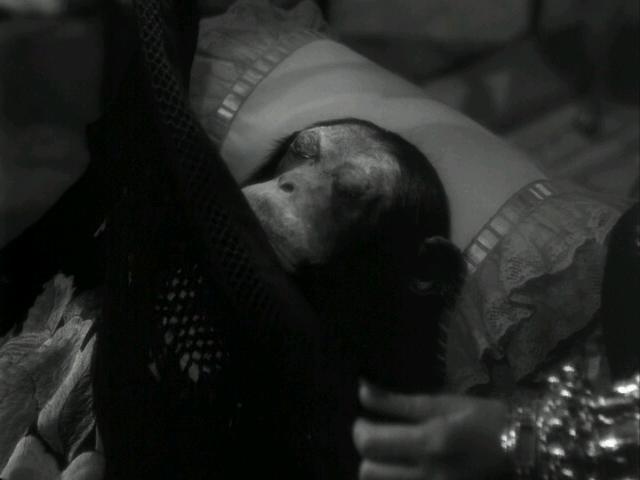
Wishing you and Norma and Max, and hell, even the monkey, a very Happy New Year! I have a feeling 2012 is going to be great!


For Norma's entire story (post shooting) see below:
Chapter 1: Norma's New Year's Eve
Chapter 2: Norma Desmond: What Next?
Chapter 3: Big Star Meets Small Screen
Chapter 4: Max Makes His Move!
Chapter 5: Norma's Halloween Seance

Tuesday, December 27, 2011

THE ARTIST


A new silent film! Oh, I had my fingers and toes crossed before walking into the theater. I have looked forward to this film for so long, I prayed I wouldn't be disappointed. Is it possible that this movie, which has gotten so much "buzz," could actually live up to all of the praise heaped upon it? For me, the answer is an unqualified "YES"!

The plot is as fragile as ancient nitrate film, but who cares? My head was spinning as the ghosts of Douglas Fairbanks, Mary Pickford, Clara Bow, John Gilbert, Gene Kelly, "Singing in the Rain", "A Star is Born", "Citizen Kane," "Cinema Paradiso," and "Vertigo" (Vertigo?) enveloped me in a classic cinematic embrace.

Lovingly written and directed by Michel Hazanavicius, "The Artist" tells the story of a great silent star who refuses to accept talking pictures and the up and coming actress whose success is cemented with the advent of sound. On the great elevator of careers, one goes up and one goes down, but can they meet in the middle?

Is it Douglas Fairbanks? Is it John Gilbert? Is it Gene Kelly? No - it's Jean Dujardin, who turns in a stunning performance. He is George Valentin, "The Artist," a man whose personality is his artistic creation. He flashes the Fairbanks ultra masculine smile, he has a Mary Pickford-like wife (Penelope Ann Miller), he dances Kelly-style and he sinks into Gilbert-like depths. He is magnetic, and he is magnificent.

Bérénice Bejo is vivacious and touching as Peppy Miller, the girl on the way up. A little bit of Clara Bow, a little bit of Nancy Carroll and a dash of Ginger Rogers, Bejo's plucky performance reminds you of that old-time glow of stardust. She is youth, she is new, but she is also a good egg and the right girl for our hero. Her scenes with Dujardin are totally charming.

Uggie as "the dog," Valentin's constant and loyal companion, rates a spot in the canine cinematic hall of fame right up there with Asta. He is not only adorable, but a major player in this story.

"The Artist" is a visually beautiful film. From the authentic 1920s-looking opening credits, to the breathtaking use of black and white film for great poetic effect, to the never intrusive but always emotional score by Ludovic Bource (with a dash of Bernard Herrmann's Love Theme from "Vertigo," used to powerful effect), this new silent film respects the genre and does not play parlor games with it. It is a silent film with all of beauty and musicality that is the hallmark of those films before sound. They were art and they were made by artists, and if you love them, then I know you will love this film. If this is your first silent film, give it a try and then work your way back to discover the true romance of film.


Friday, December 23, 2011

Thank You, Santa!

Dear Santa:


What, oh what, should I get my darling little wife, FlickChick, for Christmas?
Flicky can be so picky!
Should I get her:
A diamond tiara?
No.....it might tangle her lovely hair.

A new Bentley?
No...she never learned to drive a stick shift.


A house in the country?
No... too far from the shops.
What's that you say, Santa?
Of course! Why didn't I think of that?
I must hurry home an wrap it up nicely! I know it's just what she wants!

IT'S ME!


What better present for my FlickChick darling to find under the tree?