Showing posts with label Hooray for Hollywood. Show all posts

Saturday, August 2, 2014

HOORAY FOR HOLLYWOOD: SINGIN' IN THE RAIN (1952)

Since my slavish devotion to Lina Lamont is well known to anyone who might have stumbled by here in the past, I simply had to include Singin’ in the Rain as part of the Hooray for Hollywood series.
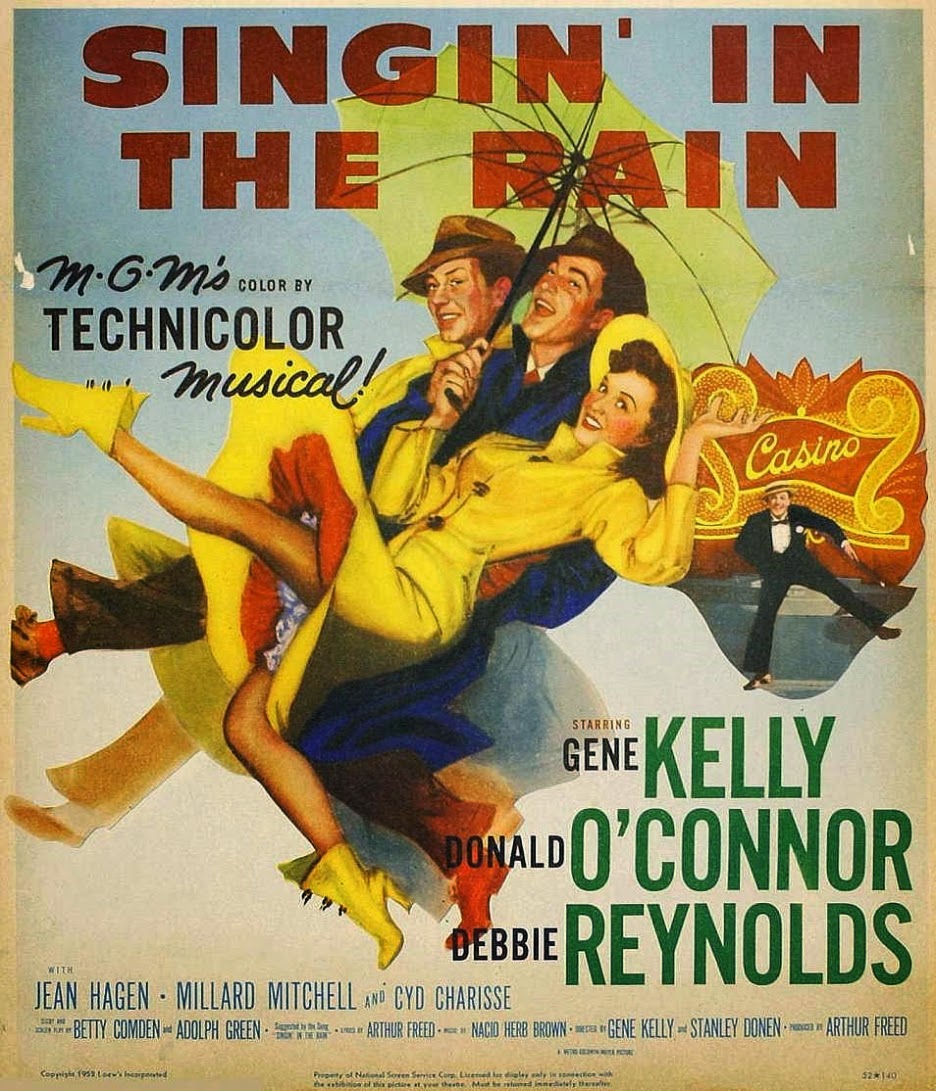
I can’t help viewing this film as a musical counterpoint to Sunset Boulevard; sort of the positive to the negative/the sun to the shade. There are those who made the transition to sound (Don Lockwood/Garbo) and those who didn’t (poor Lina/poor Norma Desmond). Filmed 20 years after the last of the silent films hit the theaters, it is an occasionally nasty, sometimes affectionate look at that moment in time when Hollywood was turned on its ear and then turned on its own.
 
Written by Betty Comden and Adolph Green, the film is based, in part, on the memories of producer Arthur Freed and costume designer Walter Plunkett, both who lived through those traumatic changes. At the advent of sound and musicals, Freed was a lyricist, working with composer Nacio Herb Brown (their music is used throughout the film) and Walter Plunkett was wrestling with sound in such early sound musicals as Rio Rita and Dixiana. He remembered only too well how the swish of a dress or the random fingering of a string of pearls could record like a thundering herd of buffalo during those early days. Singin’ in the Rain perfectly captures the panic and the joy of the new medium. It was a topsy-turvy world where great stars (John Gilbert/Clara Bow/Lina Lamont) were toppled from their thrones and virtual unknowns were elevated to star status (Kathy Selden/Alice White/Clark Gable). Some survivors thrived (Joan Crawford, Ronald Colman) while some merely or barely survived (Gloria Swanson).
 
Beyond the sorrow of the twilight of the silents lay the joy of those goofy, innocent early musicals. The Dueling Cavalier becomes the Dancing Cavalier. And Don Lockwood can dance! Who knew? Beyond the diction lessons and the technical mishaps was a feeling of joy and creativity. In the depths of the Depression, silly, gleeful musicals lifted the spirits (even if some of those chorus girls could barely lift their thighs). High spirits abounded, at least for a while. Here's the 1929 version of that famous song (from the finale of The Hollywood Revue of 1929). See how many stars you can identify.
 
Singin’ in the Rain is a bow to the Nancy Carrolls, the Buddy Rogers, the Zelma O’Neils and the John Boles - and all those crazy kids who made us feel like singing and dancing in the rain. Zelma who? Nany who? Check out Nancy Carroll and Buddy Rogers and Zelma and Jack from 1930's Follow Thu.
 
And really, what’s not to love? Kelly’s Don Lockwood is a dancing Fairbanks – dashing, masculine and a joy to behold. It is my favorite Kelly performance (and that’s saying a lot).
 
Gene and the Louise Brooks-inspired leg of the delicious Cyd Charisse
 
The great Donald O'Connor really gets a chance to show how talented he was. His signature number of Make “em Laugh is unforgettable.
 
Debbie Reynolds was cute, but probably the most expendable cast member. She was only 19 when this was made. Her tales of Kelly as a tough task-master legendary and her gratitude to him is a testament to her professionalism.
 

And of course, there is Jean Hagen, as Lina Lamont. There are few things in this world that are perfect and her performance here is one of them. Totally, 100% perfect. As a charter member of the Lina Lamont fan club I can only hope that she went on to buy the studio.
 

A lovely look back at themselves by the insiders who were there without the venom and with out the sadness that a parade had indeed passed by, Singin’ in the Rain remains a joy to behold.
 

Tuesday, February 25, 2014

HOORAY FOR HOLLYWOOD: SOULS FOR SALE (1923)

2014 is the year A Person in the Dark celebrates films about my favorite place - Hollywood!


SOULS FOR SALE


By 1923, Hollywood had already established itself as the capitol of glamour, dreams, scandal and sin. William Desmond Taylor had been murdered and the Arbuckle scandal cast a great shadow over the film industry. Still, the young and beautiful continued to make their way west, hoping for fame and glory. 

Innocent Mem and her odious husband

Souls for Sale is a fun/melodramatic/romantic entertainment that both makes fun of and glorifies our favorite town west of the Mississippi. The film opens by showing young and innocent Remember Steddon (great name, no?) on a train with her brand new husband, Owen Scudder. She is a small town girl whose preacher father spent a great deal of time railing against the evils of Hollywood. Mem (as she will be known) is having serious buyer’s remorse. As the train chugs west towards a boat that will carry her and new hubby to China, she suddenly gets the feeling all is not well. Since hubby is played by that professional cad, Lew Cody, who can blame her? Rather than spend the night with her mustachioed Lothario, Mem jumps off the train and lands in the desert. 

Is it a sheik? No - it's only a movie star

Parched and near delirious from the heat, she sees a vision in the distance: a sheik! On a camel! He jumps off his mount and rushes to rescue our heroine Is he a mirage? No – he’s only an actor! “The usual sheik led the usual captive across the usual desert.” This sly Valentino jab is one of the first of many taken at Hollywood. A wonderful movie stock company nurses her back to health and, before you know it, both the leading man and the director are in love with Mem. 
The leading lady is star struck by her director

Mem resists working in films, but our runaway bride has to earn a living, so she swallows her pride and takes work as an movie extra. This is where the film really gets fun. Mem works as an extra in Chaplin’s "A Woman of Paris," (Chaplin is seen furiously directing) and watches Erich  Von Stroheim guide Jean Hersholt though a scene in "Greed." She also bumps into Zasu Pitts, Chester Conklin, Barbara Bedford and Elliot Dexter at the commissary. Mem’s lovesick director and leading man both propel her before the camera and, shades of "42nd Street,", when a huge overhead light falls on leading lady Robina Teele, Mem gets her big chance to star in a drama of the big top. 

Mem is an extra in Chaplin's "A Woman of Paris"

Meanwhile, we learn that Mem’s husband, the loathsome Scudder, is actually a murderer who marries women and then kills them for the insurance. While Mem is making a name for herself on the screen, Scudder lands in Egypt and is engaged in swindling an English lady and her father. In a very funny turn of events, it turns out the lady is a bit of a Lady Eve and swindles the swindler. Down on his luck, he returns to Hollywood to collect his “wife.” It seems even he is susceptible to the charms of Hollywood. Instead of wanting to murder her, he now wants to love her. Meanwhile, Mem has kept the secret of her marriage from everyone, including her true love, director Frank Claymore, fearing a scandal that could ruin her. 

It all goes up in flames, literally, in the exciting climax. The circus set is engulfed in flames and the bad faux husband, who confesses that he and Mem really weren't married, dies in a wind machine in a gallant effort to save her. The cameras have kept grinding through the storm and fire and the director gets his film and his girl. 

The glorious Barbara La Marr

While not a classic film, this sure is a fun one. Check out this cast: Eleanor Boardman in a star-making role as Memory Steddon, the manly Richard Dix as director Claymore, Aileen Pringle as the larcenous English lady, Mae Busch as the ill-fated star, Robina Teele, and the ultra-glamorous Babara La Marr as Leva Lamaire, the cinema vamp with a heart of gold. Leva can not give her heart to anyone since she witnessed her love, a daredevil stunt pilot, die on a film set in a horrific crash (real life aviator Ormer Locklear died the same way). In fact, my only real complaint about the film is that there is not enough Barbara La Marr. Boy - was she terrific. Known as "The Girl Who Was Too Beautiful," I need to see more of La Marr's work! Oh, and you know the minute I saw that her name was Leva Lamaire I thought of my girl, Lina Lamont!;) Oh, and William Haines has a small but showy part. You can see the man had star power.

"Souls For Sale" was written and directed by Rupert Hughes, whose nephew Howard, made a trip to Hollywood to visit and decided he liked the town just fine. Believed lost, copies of the film were discovered in the 1980s and 1990s. A beautifully restored and scored version is available from TCM and Warner Brothers Archives.

Mem's husband's lament and proof that she is a bona fide movie star!


Wednesday, January 22, 2014

HOORAY FOR HOLLYWOOD: SINGIN' IN THE RAIN

2014 is the year A Person in the Dark celebrates films about my favorite place - Hollywood!

Singin' in the Rain

When "Singin' in the Rain" was released in 1952, silent films had been a thing of the past for only 24 years or so. Probably more than half of those in the audience remembered them and certainly many of those who made the film were there at that time when silents transitioned to sound. Cinematographer Harold Rosson started with Mary Pickford and producer Arthur Freed, along with composer Nacio Herb Brown, wrote the lyrics to music used in the film; music that was first written for those early days of movie musicals.

Here are Freed and Brown performing one of their songs in "The Hollywood Revue of 1929." Freed was a songwriter before becoming a producer.

Our hero, Don Lockwood (Gene Kelly), has the image of a devil-may-care cross between swashbuckler Douglas Fairbanks and lover John Gilbert. It is an image larger than life and perfectly suited to the silent screen where viewers can flesh out a character with their imagination. George Valentin, the leading character of the recent "The Artist," bore a resemblance to Kelly as Fairbanks/Gilbert.

Don's co-star, Lina Lamont (Jean Hagen), complimented him perfectly as the elegant screen goddess. Together, they heated up the screen. The fact that they were lovers off screen only added to their appeal.


What their fans didn't know was that Don hated Lina and that Lina was a delusional dodo bird with a voice like nails on a chalkboard. As we know, Don and his loyal friend Cosmo (Donald O'Connor) make the transition to sound (along with ingenue Kathy Selden, played by Debbie Reynolds) and Lina is, presumably, laughed off of the screen.

What a cast! Feast on some best moments:


Aside from the music, the dancing and the great performances by the perfect cast, what makes this movie so endearing is the feeling that the people who put this together had experience in that time and place. The depiction of panic that overtook Hollywood feels real, the bad sound, the bad voices, the outmoded characters, the diction coaches, and Lina's cry that she can't make love to a bush all have the ring of truth and, even while they are being kidded, there is a feeling of affection.

While too much credit cannot be given to Kelly and director Stanley Donen, as well as to Donald O'Connor for his wonderful chance to shine and Cyd Charisse for her elegant channeling of Louise Brooks, my heart really belongs to Jean Hagen's wickedly funny and touching Lina Lamont (I am a charter member of the Lina Lamont fan club - for more, read HERE). Poor Lina - a silent screen goddess who made her studio tons of money deserved a better fate than ridicule - and that is my only complaint about this glorious film. Monumental Studio boss R.F. Simpson, along with Lockwood and Cosmo, are awful adolescent bullies. True, Lina was mean to Kathy, but public ridicule was pretty mean! However, I guess that's the message - Hollywood ain't for sissies! Hopefully, Lina licked her wounds with the help of a fat bank account.

So, can I resist posting the 2 powerhouse numbers? No way!


This post is dedicated to the awesome Lina Lamont - may she never be forgotten!!

A shimmering, glowing star in the cinema firmament!