Sunday, November 9, 2025

Employees' Entrance: The Monsters We Make

This is my entry in The Classic Movie Blog Association Early Shadows and Pre-Code Horror Blogathon. Click HERE for more monstrous fun.

This store is an HR nightmare

Film and literature have given us non-human monsters who sometimes serve to instruct us about or illuminate our own inhumanity. Some are fearsome, some are weirdly touching, some bring out the best in mankind, and some bring out the worst. But there is no more horrid monster than the kind our society makes and allows; you know, the ones who walk among us and look just like us. They are the ones who not only are allowed to live, but are encouraged to thrive. They are the ones who gleefully hold up a mirror to our society and proudly say "look what you've made."

A wolf in a Brooks Brother suit is still a wolf

1933's "Employees' Entrance" is such a fun Pre-Code feast that it is easy to check your emotions at the door and enjoy all it has to offer. First and foremost, it has Warren William at his leering, lupine best. Here he is Kurt Anderson, the manager of a large department store. It is a position of considerable power and he wields it with glee and gravitas. How tiresome his day is! He is surrounded by ninnies everywhere. From the snooty do-nothings that make up his Board of Directors (but who love that fact that he makes them money), to his uninspired co-workers and business associates (one whose suicide elicits the bloodless response from Anderson that the man had outlived his usefulness), Anderson is the ruthless self-made man rising from the ashes of the Great Depression. So, who would begrudge this hard-driving workaholic a little fun? After all, even monsters need to relax.

The job interview

And boy does this guy take his relaxation seriously - almost as seriously as his work. You see, Anderson just loves the ladies, especially those young, vulnerable ones who depend on him for a living. He is the classic predator. And who was more vulnerable and lovely in 1933 than the moist and luscious Pre-Code  Loretta Young? While Loretta later became rather great lady-ish on screen, her Pre-Code films reveal a very sexy gal of fungible morality. Here she is the perfect prey, a down-on-her-luck beauty who desperately needs a job. She tries that old trick of keeping Anderson at bay without insulting him, but this wolf will not be denied. He's played with amateur babies before. After a night of too much drink (Prohibition has ended. Yay!) and some personal turmoil due to the fact that she is secretly married to another employee, Anderson makes his move and rapes her. 

Some store goods are not for sale to the general public

Make no mistake. Although he has been given a bit of a sorrowful back story (love lost and all), Anderson is a monster. But monsters can not move among us unless they have help. In "Employees'' Entrance" the chief helper in the seduction game is Alice White at her cunning, conniving but somehow pathetic best. She, too, needs to survive and she throws her lot in with the monster. She helps Anderson in a direct, quid pro quo way, but there are other helpers, so many of them, whose silence enables Anderson to thrive.


Alice White reminding her boss of her value to the company

Now before I get all huffy, let me say this is quite an eye-opening, fast-moving and sometimes funny film with lots of snappy dialogue peppered throughout. Was anyone as dangerously oily as Warren William? Was anyone more beautiful than Loretta Young in 1933? Add the always welcome Alice White and the stable of Warner Brothers supporting players and you will definitely be entertained for 75 minutes. Because it is Pre-Code, Anderson is not required to pay for his past bad behavior and he is allowed to soldier on behind his power desk even though Loretta manages to escape his clutches. However, there are those lurking in the shadows who seek to supplant him - monsters that Anderson has helped create. So, maybe karma awaits Kurt Anderson after all.

A Pre-Code feast: back off, Barrymore - Warren William is the real "great profile." And any time Alice White appears, everything just seems better.

Now for the rant. "Employees Entrance" is one of those films that you can only enjoy is you are able to view it through the lens of the time it was made. Once you do that, you can sit back and enjoy. But I'll wager you will find it impossible to watch this film in 2025 in America and not draw parallels to our current headlines. Monsters and their helpers still exist. And it is not funny, and it is not charming. Victims rarely get a happily ever after and it all doesn't go away in 75  minutes. That, to me, is scarier than any fantasy monster born in a laboratory.


Sunday, June 8, 2025

Evalyn Knapp: Not Just Quite.....

Why do some performers make it into the unquestioned "star status" stratosphere and others not? Many are just as talented, just as beautiful and just as willing as some of Hollywood's classic greats, but why do some make it into that special circle and others just fall short? It must be that intangible special quality called "star power."

Evalyn Knapp looking like she should be a star

Betting on Evalyn: Lucky 15

Take for instance Evalyn Knapp. She was one of 15 hopefuls in 1932, part of that promising gaggle of gals known as WAMPAS Baby Stars, that annual promotional affair run by the Western Association of Motion Picture Advertisers. The purpose of the campaign was to select 13 young actresses who the association was betting on becoming bigger stars. While most of these ladies failed to live up to the promise of great stardom, a few, such as Clara Bow, Colleen Moore, Joan Crawford, Joan Blondell, and Loretta Young did manage to fulfill their promise. The class of 1932 was so  filled with promise that 15 young actresses were selected. This embarrassment of riches included Evalyn along with Lona Andre, Lilian Bond, Mary Carlisle, June Clyde, Patricia Ellis, Ruth Hall. Eleanor Holm, Dorothy Layton, Boots Mallory, Toshia Mori, Ginger Rogers, Marian Shockley, Gloria Stuart, and Dorothy Wilson. Many went on to respectable careers in film, but clearly Ginger was the best of the bunch. 

From her earliest appearances in film in 1930,  Evalyn was under contract with Warner Brothers. Another ingredient in Hollywood success is the faith that a studio has in their performer. The studio had to believe that the person they had under contract was worthy of the investment: the publicity, the parts, the grooming. Evidently, Warner Bothers felt Evalyn was worth it and they bet on her becoming a bankable star.

Evalyn (top right) along with her fellow WAMPAS Baby Stars
Joan Blondell (1931), Lilian Bond (1932) and Marian Marsh (1931)


Looking glamorous as she seduces and cons
Edward G. Robinson in "Smart Money" (1931)


From 1930 to 1943 Evalyn was featured in over 50 films. She worked a lot, often with the biggest names at the time, but rarely made it into the name above the title category in major studio productions. The few times she did get star billing, it was at poverty row-type studios such as Goldsmith Productions, Chesterfield, Monogram and Screencraft  where she worked more frequently during the 1930s. Eventually, Warners lost interest.


See? Just not that interesting

There is definitely something interesting about Evalyn, but just not that interesting. She doesn't light up the screen the way fellow Warners performers Blondell and Rogers did. She seemed nice - and maybe in those days of Depression cynicism that was the problem. Or maybe it was just her vibe that says "I'm not really all that interested in being a movie star."

At any rate, Evalyn did find her groove in film, just not in parts dripping with jewels. She became the reliable heroine of westerns such as "In Old Santa Fe" and  "Rawhide" (starring Lou Gehrig) and serials like "The Perils of Pauline."


Evalyn married in 1934 and remained married until her husband's death in 1977. She dabbled in film and made some appearances where her name appeared way down in the cast list, sometimes even uncredited. Her last appearance on film was in 1943. She passed away in 1981 at age 74. A nice career, just not the one on which Hollywood placed a bet.


Saturday, May 10, 2025

Crying at the Movies

This is my entry in the Classic Movie Blog Association Cry Me A River Tearjerkers Blogathon. Click HERE for more weepies - and don't forget to bring a hanky.

So, here's my story.

I was walking down a dark street of the soul when James Cagney grabbed my hand and pulled me into the light. He did this not once, at least twice, and maybe a few more times that I can’t specifically recall.

The last time this happened was a month or so ago at a screening of "Ragtime." Of course, it wasn’t the real and long-dead James Cagney. No, it was the glittering, electric, oh so alluring silver screen shadow Cagney. The one that never dies.

The first time this happened was when I was 12. Oh gosh, I loved that adolescent girl, standing on the brink, thinking and believing everything she desired was possible. Time was an unending runway. Like a cattle brand, those first and early passions that rise past mere wants were imprinted in me. And even now, after the slow, sometimes dreary, sometimes wonderful blink of an eye that passes for life I can rub my figurative finger over my true self and still feel the faint impressions of that brand.

Funny. We seem to spend the first part of our life developing an armor against hurt and then the remainder peeling away that armor in search of our authentic emotional self. This leaves a tender spot, and as a consequence, we cry a lot. And not just over sad things. Which brings me to this little clip, the closing credits of 1984's "All of Me."

Cute, right? Yet, every time I see it, I start to sob real tears. But all tears are not an expression of sorrow or hurt. At this point in my life, those emotions bring a frown and something in my chest that feels like heartbreak. Now it is joy and beauty that elicit those tears. Steve Martin and Lily Tomlin are pure joy, happiness, unbridled silliness -a great and beautiful thing. 

I've been writing about movies for quite some time now. I'm not much of a reviewer. I like to explore the emotional experience of watching a particular film, which brings me to "Ragtime." Cagney was 82 at the time that movie and his role was small, yet the sight of him made me cry. I cried not because he was so changed from the way he looked in his prime. No, I cried because in his face on the screen I saw all of the history and stories I had written on my heart tangled up with his cinematic history and how grand a ruin he appeared and how raw and real I felt in my seat, in the dark, deep in rapture, crying and filled with joy.


Sunday, November 10, 2024

The Time of Their Lives: Bud and Lou Every Night at My House

This is my entry in the Classic Movie Blog Association's A Haunting Blogathon: In the Afterlife. For more eerily delicious articles, please visit here.

Bud and Lou on opposite sides of the revolution in 1946's "The Time of Their Lives."

My Father: How many times can you watch the same film?

9 year old me: a lot.

If you grew up in the New York metropolitan area in the 1960s - 1980s, you probably remember Million Dollar Movie. Twice nightly for an entire week channel 9 would run the same movie. The opening theme was especially memorable. Upon seeing "Gone With the Wind" for the first time in its theatrical release in 1967, my friends and I (and probably a bunch of others in the theatre) exclaimed "that's the theme from Million Dollar Movie!" when we first heard Tara's Theme.


The same movie every night! What joy during an era when there were no VCRs, no DVDs, No DVRs and no cable or streaming TV! I wonder how many little movie lovers followed that siren song that opened the door to classic movie mania (and I write that without an ounce of shame). My brothers happily watched "Mighty Joe Young" every night, but my favorite, by far was Abbott and Costello's "The Time of Their Lives."

Bud and Lou were already well known in my house via reruns of their television show (an afternoon ritual). Seeing them in a story, and such a funny and rather scary story, only made me love them more.

Ghosts Lou Costello and Marjorie Reynolds realize they are ghosts condemned as traitors

"The Time of Their Lives" is an un unusual Abbot and Costello film because Bud and Lou are not a team here. In fact, Bud is the target of Lou's antics. Briefly, Lou plays a Revolutionary War era tinker named Horatio Prim. Horatio was a patriot who wanted to earn enough money to buy his servant girl sweetheart out of her indentured servitude. In the meantime, a plot with Benedict Arnold was afoot. In a case of mistaken identity (what else?) he and patriot lady Melody Allen (Marjorie Reynolds) are taken for traitors, shot, their bodies thrown to the bottom of the well and bound by a spell that condemns them on the Danbury property unless they are proven not to be traitors. Of course, the real traitors were butler Cuthbert (Abbott) and Melody's fiancé, Tom Danbury. A letter from General Washington could clear the doomed duo and one did exist, but it was hidden by the duplicitous Tom. 

Fast forward to modern times and the old Danbury estate has new tenants. Horatio and Melody have been rambling around the property for centuries, but this new crew moving in consists of a Cuthbert look-alike (Abbott again as Cuthbert relation Dr. Greenway) and a few other non-believers. The ghosts are able to communicate their plight via psychic housekeeper Emily (Gale Sondergaard), Washington's letter is found thanks to a message sent by the repentant Tom, the cursed duo are united in Heaven with their loved ones and Cuthbert/Greenway finally gets punished.

What charmed me as a kid were the special effects. The ghosts have some fun with cars and radios and the fact that they can walk through walls. When Melody spots the beautiful fashions of the day and dresses up in a modern evening gown and jewels, only the clothing and jewelry are visible to mortal eyes, setting the stage for only a pair of stockings running up the stairs past a terrified Binnie Barnes.


A special shout out to Gale Sondergaard as Emily. She is Judith Anderson's equal when it comes to creepy housekeepers (making Binnie Barnes's line "didn't I see you in Rebecca?" even more amusing) and I can still hear her spooky way of calling to Melody as the long-dead Tom Danbury during a séance (Mel-o-deee.....Mel-o-deee). 

"Didn't I see you in Rebecca?"


Those ghosts are real!
I apologize for taking so long to get to the main topic here, but truly, the main topic is that every night viewing that prompted a question from my father that I have not yet been able to provide a quantitative answer. 

Sunday, June 23, 2024

Why Do We Blog?

A funny thing happened recently. 


I received a comment on a post written over 13 years ago from a fellow in, of all places, Ireland. The post was my little love letter to Clara Bow (https://flickchick1953.blogspot.com/2010/10/clara-bow-i-want-to-be-happy.html). Imagine my surprise to see this new comment:

Many, many thanks for your beautiful article. (Over a decade late, but still!)

Here in Ireland we are having a special showing of 'It' on June 15 and I have 'borrowed' a paragraph from you for an accompanying piece - with full credit to both you and the blog, of course!

I am currently enjoying going through your archive and enjoying it very much! It's always so great to come across genuine enthusiasts.

Greetings and warm regards from

Charley Brady

Silent Cinema Galway.

Here is Charley's great article.

https://www.silentcinema.ie/blog/hot-girl-summer-clara-bow.amp

When you write something and push it out there into the black hole of the blogosphere, you never  know if it lands anywhere, much less gets read. Receiving a communication like that, from someone so far away about something written so long ago, kind of validates why we blog.

* How great it felt to share something with a kindred spirit.

* How great to have your work appreciated.

* How great to learn about someone doing something so wonderful so very far away. 

* How great to find a new site and learn and enjoy more about classic film.

And so, every now and then, as the spirit moves me, I'll keep at this.


And if this just gets sucked into that black hole, well so be it - and in another 10 years ago, it might just land.

Please check out Silent Cinema Galway - it's a  beautiful site:

https://www.silentcinema.ie/_blog#_blog

I'm sure special screening of "It" was a success - how could it not be?

Sunday, May 19, 2024

One, Two, Three - Seasoned Cagney Can Still Spice It Up

This is my entry in the Classic Movie Blog Association Screen Debuts and Last Hurrahs Blogathon. Click here for more memorable firsts and lasts.

Cagney and the grapefruit make one last joint appearance

Season is an interesting word. It can mean to add flavor to something, or it can define a period of time. In the case of James Cagney, from day one he always seasoned the screen with some invigorating cinematic spice. He was also a performer who, in over 30 years, presented himself to the audience in various seasons of his acting life. From the summer of "The Public Enemy" to the winter of "Ragtime," Cagney not only physically matured, but also matured in the depth and humanity he brought to his roles. All before our eyes. While those two winter roles - the aforementioned "Ragtime" and the final performance in the television movie "Terrible Joe Moran," gave us a final glimpse of a cherished star, it is the late autumn performance in Billy Wilder's "One, Two, Three" (1961) that offers us the final major performance of a great star. At age 62 he was as dynamic as he was 30 years earlier.

Not as well known as many of Wilder's other great films, "One, Two, Three" is a sharp, sly and very funny look at the cold war and corporate moral flexibility (to put it kindly). A lot of the topical humor may be lost on those who didn't live through the cold war or are not familiar with it. Originally slated to be filmed in Berlin, the crew had to quickly relocate to Munich because those pesky Russians decided to build a wall. The dialogue is filled with topical references (do modern audiences know who Khrushchev was, or the significance of the shoe banging on the table?). Fortunately, I am old enough to remember (wow - that's the first time I ever had occasion to use that phrase!).

Proving the cold war could be fun

Thanks to Wilder's script (co-written with I.A.L. Diamond) and direction, this all results in fast and furious fun. The supporting cast of Horst Buchholz, Arlene Francis, Pamela Tiffin, Lilo Pulver, and especially Hanns Lothar as Schlemmer, is top-notch. Cagney proves to be a good sport, allowing  several jokes at the expense of his long career - the grapefruit, the gangster quote from "Little Caesar" (even though that was uttered by Edward G. Robinson, it still harkened back to those good old gangster days), and a Cagney impression by Red Buttons. While those references made gentle fun of Cagney's decades-long public reputation, in true double-edged-sword Wilder fashion, it also seems an homage to many well-loved movie memories; an acknowledgement that we are in the presence of a living cinematic legend. I was getting those Norma Desmond/Gloria Swanson conflicted vibes here, though not in such a tragic framework.

An executive's work is never done

The film is very early 1960s, and I admit it's a bit arresting to see this particular star as a man of the modern world. For some reason he always seemed to be a man who lived in a past era. Even when his character was current in the 1930s and 40s, he seemed a man who lived by an earlier code. Cagney wears the 1960s suits and ties well and proves that he was a real actor playing something he never tried before - a slimy, married Coca-Cola executive, always conniving while canoodling with his mercenary secretary on the side. Still, he manages to retain that special sympathetic star shine something. That was his super power. Even when he was a gangster he was never slimy. Come on, weren't we all rooting for Rocky Sullivan?

Love and Capitalism wins the day

Cagney's personal struggles during filming are well known. While he could wear the clothes of the modern man, he was privately uncomfortable. Besides butting heads with Wilder, a very strong-willed director, he came to actively dislike co-star Horst Buchholz. In his autobiography, Cagney, who rarely had a harsh word for any co-workers, openly complained about the scene-stealing ways of the younger actor. Add to that those wildly changing times and Cagney decided he had had enough. At the end of filming, there seemed no place for him to go but to his beloved farm and let the world go by for a few decades. 

Cheers to you!

For some reason this topical and breathless movie reminds me of a line in Checkhov's "Uncle Vanya" about "autumn roses, beautiful, sorrowful roses." I feel a twinge of sadness in between the laughter. There would be those two graceful appearances much later, but watching this now, knowing this would be the last time we would see him in full power, is truly like looking at the twilight of the gods.


Friday, May 3, 2024

New Movies Do Not Fill the Landscape of My Dreams


Why do I find going to the movies to see new films so unsatisfying? I want to keep an open mind and heart and want to support the theatergoing experience, but I rarely, if ever, find new films at the theaters truly, madly, deeply enjoyable. They might be truly enjoyable. They might be madly enjoyable, and they might even be deeply enjoyable. But rarely, almost never, are they meet the truly, madly, deeply threshold for me. Why?

The answer is in the title of this article and it came to me while watching Peter O'Toole in "Goodbye, Mr. Chips." Objectively, the film is not great, although it has a lot going for it. It's very long, a little full of itself, and the score is forgettable. But, it has the captivating Mr. O'Toole, who always leaves nothing unfelt or unexpressed, and I saw it when I was a teenager when the landscape of all that I would love forever and always was being painted on my psyche.
I've read countless books about Charlie Chaplin and one of the things that touches me is how the trauma and longing associated with his childhood poverty and fractured family were embedded in all of his work. What scarred him, what inspired him, what frightened him and where he found beauty was imprinted on his soul at a tender age and there was no changing that no matter what life held. Fame and wealth and celebrity could not change it, nor could the reversal of professional fortune. Time revealed the public's changing tastes, but Chaplin could not change at his core.
And so I find it to be with me. The films that drew me to them were the ones I discovered early on. What is charming, what is beautiful, what is good and what is desirable all were found in the movies I saw in my youth. Films that moved me after I became an adult somehow were related to the same type of film. I probably should have gotten some of that stuff from family life, but clearly I needed to seek them elsewhere. While not at all a horror of a childhood like Chaplin's, I admit there might have been a few things lacking. Or maybe I just had a dreamer's imagination. Mercifully, there were movies. And I am so very grateful that I can access so many of my favorites upon demand these days and not wait until 3 a.m. to watch the Late Late Late show ( I did stay up until 3 once to watch a Bing Crosby film when I was about 12). They are like a comfortable blanket or a hug from a friend. At some point during those formative years, a private understanding between myself and Cary Grant, Crosby, Chaplin, Gene Kelly, Fred Astaire, both Hepburns, Bette Davis, Olivia de Havilland, Bob Hope, and especially Cagney was established that endures to this day. We truly, madly, deeply get one another. If this sounds weird to you, your landscape and mine are completely different.
So, today's films, for so many reasons, can not connect with a landscape of dreams and desires that has been built and fortified over time. It can not change and I don't want it to change. I like it. I only hope that young people who go to the movies are building their own internal landscape with images and feelings that will stay with them throughout their lifetime.  

Thursday, February 15, 2024

I Don’t Care How the Sausage is Made: Give Me the Magic, Give Me the Make-Believe

I've been blogging a long time (13 + years) – lately not so much. I mean, after a while, you kind of run out of novel things to say. Plus – man, are there some great classic film bloggers out there. I am amazed, not only at their writing ability, but at their intricate knowledge of all the things that go into making movies. You know, all that behind-the-scenes stuff, like writing, directing, cinematography, etc.

It might be hard to keep your mind on the screen here....

Alas, I am nowhere in the same league. Sometimes I just feel like throwing in the towel because I am not an expert in anything (and don’t have the nerve to pass myself off as one).

But.

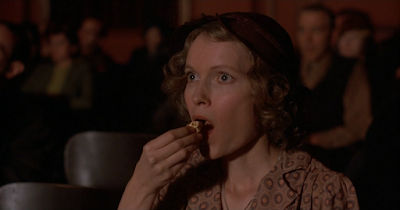
But I do admit you would have to go a long way to find my equal when it comes to being starstruck. Those pictures you see of the enraptured movie goer, sitting on the edge of their seat, hand poised between popcorn and mouth, eyes wide and glued to the screen? Yup, that’s me.

Yes, Mia, I totally get it.

Billy Wilder has William Holden as Joe Gillis in “Sunset Boulevard” say “Audiences don’t know somebody sits down and writes a picture; they think the actors make it up as they go along.” Of course I know that. But, when I’m lost in a film, I don’t care. I want to believe. Maybe that’s the filmmakers curse – they work so hard at make believe that their own contribution is ultimately ignored. Do you sit though all of the interminable credits at the end of the film these days? I don’t. I just want to see who was in it.

You know how you can pretty much find a Seinfeld episode that relates to every incident in life? Well, I can pretty much do that with movies. I have to keep those references in my head most times, because I’ve had the “poor thing: can’t relate to real life” look too many times. Or worse, the “WTF is she talking about?” look. Actually, I kind of like that one.


There is nothing like a great star of the classic era. I’m aware that it took an entire industry to produce such glorious beings for our consumption, but I don’t want to know. I don’t care that Rita Hayworth had her hairline painfully altered, I only care to see her shimmering image on film. I want to believe that they emerged – full-fledged and fascinating – on the screen.

Charles Foster Kane had his Declaration of Principles. No matter that he betrayed each and every one of them, but he had them. And here are this lowly starstruck willfully ignorant fan’s Seven Rules of Classic Film Fascination:

1. There must be music in the background: Does mood music follow you around all day? Well, in the movies it does and it is perfectly normal. No questions asked.

2. Do you wake up in full make-up and perfectly coiffed hair? Only movie stars do. They really do.

3. Can life’s stories be brought to conclusion in approximately 2 hours or less. In the movies they can. Or at least, in most classic films they can. Anyone see “Oppenheimer” or “Killers of the Flower Moon”? Either learn to tighten it up, give us a potty/snack bar break or make a streaming series.

4.  Only a great star can invite the illusion of intimacy. All the behind the scenes stuff can't make that.

5. There is always, always, an elegance about a star. And something unique – they neither look, nor sound, nor move quite like anyone else.

6. A film is not totally absorbing unless there is a star. A cast of unknowns don’t cut it.

7. How will you know 1-6 combine to create the brew that is a star or an unforgettable film? You will know it’s magic when it lingers in you thoughts and dreams, when it interjects itself into your real life, and when you never tire of repeated viewings of images or a film.

I am not now and never will be a film scholar, although I have lots of odd facts rumbling around in my brain. Please don’t ask me about geography, but I can tell you a lot about Clara Bow. I was what the movies was made for: open to magic, open to dreaming, open to the secret life that lives within.

Go on...ask me

Maybe I’ll go on blogging, maybe not. I started blogging because I felt the need to share my love of the movie-going/watching experience, but maybe this one entry is all I have left to say. I do like participating in some blogathons because it forces me to write, but right now my only topic is that of surrender – surrender to the magic of the finished product. It's bliss in a world filled with anything but at times.


Sunday, December 17, 2023

Lina Lamont and Billie Dawn: Sisters From A Different Mister?

Sometimes things are so obvious you just can't help but wonder: Were Lina Lamont ("Singin' in the Rain") and Billie Dawn ("Born Yesterday") related?

We don't know anything about the parentage of Miss Lamont and only know that Billie's dad worked for the gas company.  Let's take a look at a few undeniable truths.

First: obvious physical and seductive resemblance. You see it, right? Sisters? Mother and daughter?

Second: the even more obvious vocal resemblance. I mean, really - can there be any doubt that these two have a memorable -shall we say - tone? 


Sorry for any ear bleeding here,

Third: the shared impression that both were not bright when, in fact, they were smart cookies. While Billie mastered her civics and brought down a millionaire crook, Lina knew all the ABCs of her studio contract.


Fourth: while we know that Billie's first name is really Emma, we don't know her given last name. And it's a pretty good bet that Lina Lamont is not the lady's real name. It has proved impossible to obtain actual birth certificates for each gal and back then there were no DNA tests.

So, I'm going to posit, without any proof, of course, that somehow these 2 are related. Billie would have to be the kid sister, of course or...could it be that somewhere, somehow, Lina had an affair with the gas man?

I leave it to you to ponder. 

Sunday, November 19, 2023

The Sweet Smell of Success: The Cat's in the Bag and the Bag's in the River

 My local library is kind enough to indulge my desire to share my passion for classic film by allowing me to show a classic film once a month. And once in a while, a few film fans wander in and share the enjoyment. 

November's Film: 

The Sweet Smell of Success

1957's "The Sweet Smell of Success" is a glamorous black and white vision of the seedy New York gossip world of the 1950s. Before TMZ and the internet's instant update on the rich and infamous, there was the gossip columnist. While Hedda Hopper and Louella Parsons were well known on the west coast, New York City had Walter Winchell, a columnist who wielded his power to make or break people with an iron and vicious typewriter. In "The Sweet Smell of Success," Burt Lancaster is J.J. Hunsecker, a thinly disguised version of Winchell. While he cloaks himself in a cynical suit of respectability, his is a world devoid of morals  and filled with sleaze. His chief officer in charge of sleaze is struggling publicist Sidney Falco, played by Tony Curtis in a dynamic performance. Hunsecker's downfall is his shall we say "unusual" attachment to his sister, Susie. Isn't that always the way? Anyhow, to watch J.J. and Sidney weave a spider's web of malice only to be caught in it is a joy to behold.

Aside from the two stars at the top of their game and dialogue that snaps and crackles, New York City, backed by a great jazzy Elmer Bernstein score, is the third star of the film. The film captures the city in the last glittering days of nightclubs, cocktails and fur coats. It's fun to spot the long gone stores you knew in the street scenes and to see legendary nightspots like The 21 Club and Toots Schor's in all their glory. 

A couple of special mentions: Barbara Nichols tugs at your heart as a cigarette girl (remember them?) who is badly used by the men she knows. 

It's also a chance to get a glimpse of the great vaudeville artist Joe Frisco playing a nightclub comedian. It's a small part, but just the thought that he was cast is a bit of a bow to New York's entertainment past.


Sunday, November 5, 2023

Leave Her to Heaven: When Beauty Disguises the Beast

This is my contribution to the Classic Movie Blog Association's Blogathon and the Beast event. Click here for more beastly good reads.

Leave Her to Heaven: 

When Beauty Disguises the Beast


In the eternal cinematic battle between good and evil, virtue must always contend with the beast. Now, when the beast looks like these guys, he's not so hard to resist.


But, when the beast looks like this, well, it certainly complicates things. And that's what makes "Leave her to Heaven" so much twisted fun.


As with the serpent of old, the beast in Ellen Berent (the impossibly gorgeous Gene Tierney) reveals itself slowly. It takes time for poison to settle in and work to its full potency, even in the host.

Our beauty is a predator, and the beast in Ellen is a maniacal, possessive jealousy that causes her to destroy anyone who threatens her prey's singular fascination with and devotion to her. 

strangers on a train
The prey in this story is author Richard Harland (a totally interchangeable-with-any-leading man Cornel Wilde). They meet cute on train in New Mexico. Ellen is just getting over the death of her father to whom she was VERY devoted and who, it appears, was very devoted to her. What to do with all of that singular and obsessive devotion? Why, transfer it all on to Richard, who reminds Ellen of her dad. Naturally.


off to a happy start....

As with all doomed love stories (movie-wise), things get off to a great start. Richard meets the family. It's all so lovely, but there are warning signs. Mother Berent seems resigned to have been the third wheel in her dead husband’s and Ellen’s relationship. Cousin Ruth (a virtuous Jeanne Crain) keeps mom company and kind of fills the emotional space where daughter Ellen should be.

Ellen coolly ditches her attorney newly ex-beau Russell Quinton (Vincent Price) in favor of Richard and announces that she and Richard are to be married. That’s news to Richard, but Ellen’s power is too alluring to overcome. They wed. Ellen’s little paradise seems to be working – she is completely adored by her new husband. But is she?

It's the word “completely” that causes the beast to rear its ugly head. Richard has other loves – a disabled younger brother and his career. This makes the beast unhappy and you can hear the gears clicking in Ellen’s brain – how can she destroy them?

Richard loves his home, called Back of the Moon, in Deer Island, Maine. The remote location is perfect for him to write. Ellen hates the place.

Ellen "helps" Danny with his swimming regimen 
The tense situation only gets worse when Danny comes to visit. Taking the boy out for a swim, the unthinkable occurs and Ellen watches the boy helplessly drown before her eyes. A truly unforgettable scene of detached and compassionless evil.

and then watches him drown
From there, things go from worse to worser (I know, not really a useable word, but what’s worse than worse?). Cousin Ruth offers Richard a sympathetic ear. While Ellen may have driven Richard to Ruth, Ellen's jealousy Spidey sense here was not off base.

Cousin Ruth: a pretty shoulder to cry on
Eventually the beast begins to consume its host. Faced with an unwanted pregnancy, Ellen goes full beast. In fact, she refers to her unborn child as "the little beast." Unless a Rosemary’s Baby is cooking in the oven, she is fingering the wrong beast.

before the fall...getting it just right
She is a clever cookie, though. Why not kills 2 birds with one stone? Ellen manages the old fall down the stairs to terminate the pregnancy move. When she confesses her actions to Richard to prove the depth of her singular devotion, Richard leaves her. To add insult to injury, he dedicates his next book to Ruth. At this point Ellen is fairly glowing green.

Poison comes so naturally to Ellen
The last act of this beautiful beast is to take poison and try and frame Ruth. While this proves a bit of a headache (which involves some over the top theatrics from Vincent Price’s attorney) and some jail time, the beast is dead and Ruth and Richard are free to live happily ever after.

Old flame Russell Quinton grills Ruth.
Ellen is dead, but her spirit is in a courtroom painted green with envy
It wasn't that Ellen loved too much, as her mother told Richard, it was that she smothered (and drowned) anyone who her beloved dared to love or admire besides her. Face it, the girl just couldn't stand to share.

The beauty of the film is not only Ellen. The costumes, the color, the settings, all contribute to a feast for the sense that leaves you rather full like a dinner where you've had too much to eat. It is all too tasty, all too uncomfortable and all too deliciously much in a most discomforting yet satisfying way. 

As mentioned, Gene Tierney's costumes (designed by her husband Oleg Cassini ) and the various homes featured in the film are simply to die for. Here's a sampling:

The Costumes

notice her initials?

The Homes

1. The New Mexico Home (my favorite)


2. Back of the Moon (Deer Lake, Maine)


3. The Bar Harbor Maine House