Thursday, May 9, 2019

Joan Crawford: A Face and a Whole Lot More in "Our Dancing Daughters"

This is my entry in the Joan Crawford: Queen of the Silver Screen Blogathon, hosted by Pale Writer and Poppity Talks Classic Films. Click HERE for more Joan.

"Joan Crawford is doubtless the best example of the flapper, the girl you see in smart night clubs, gowned to the apex of sophistication, toying iced glasses with a remote, faintly bitter expression, dancing deliciously, laughing a great deal, with wide, hurt eyes. Young things with a talent for living." F. Scott Fitzgerald


1928's "Our Dancing Daughters" is generally accepted to be the film that made Joan Crawford a star. Since 1925 Joan had been toiling away at MGM first appearing as Norma Shearer's double in "Lady of the Night," and quickly working her way into supporting roles with important stars by the end of the same year. As Norma Desmond rightly proclaimed, silent stars had "faces," memorable canvases of expression that provoked emotion in the audience. With her large, expressive eyes and classically contoured face and profile, Joan clearly had a "face." But soon, film stars would need more than a face.

An unforgettable face

"Our Dancing Daughters" is the story of 3 flapper girls friends, all part of the "smart set." They go to parties, laugh a lot and flirt with boys.


Dorothy Sebastian, Anita Page and Joan Crawford
Diana Medford (Joan Crawford) is known as "Dangerous Diana," and is the leader of the pack. She is a good-time girl on the outside, appearing to be free and easy, but her frivolous persona masks a virtuous heart. Female virtue is really important in this film.

Beatrice (Dorothy Sebastian) is the fallen friend who must always, always pay for her transgression.

Ann (Anita Page) is the outwardly sweet and virtuous girl who is anything but. Schooled by a materialistic mother that money and prestige are all that matter, Ann is on the hunt for a wealthy husband.


Naturally, Diana and Ann fall for the same man (Johnny Mack Brown as Ben). Although he really loves Diana, he is fooled by her outward devil-may-care attitude and Ann's sweet and seemingly innocent demeanor. He picks the girl he thinks to be most virtuous. Beatrice, meanwhile, marries Norman (Nils Asther), the man who loves her but can't seem to get past the fact that he was not "the first." By the way, Nils Asther had one of the best sneers in the movies.


Norman loves Bea, but he can't stop giving her a
hard time over a past romance.
Ann and Ben's marriage breaks Diana's heart and she decides to go away for a while. Meanwhile, Ann scorns her husband and is unfaithful. Ben, having enough of her lies, decides to go to Diana's farewell party. There, he and Diana reaffirm their love for one another and are confronted by a drunken Ann, who doesn't want her husband but wants the luxurious life he gives her. After a drunken outburst, she takes a fatal head first tumble down a flight of stairs and paves the way for Diana and Ben to finally get together.

Joan Crawford's star-making role revealed a fresh, youthful and compelling performer. Her face beautifully expresses every deeply felt emotion and, truly, you can't take your eyes off of her. I'm reminded of a quote by Louise Brooks who said Joan danced like a lady wrestler. She does put a lot of muscle in her dancing, but it's her acting and her presence that captivate.

A word about Anita Page


A drunken Ann puts on quite a show
As fabulous as Joan is in "Our Dancing Daughters," the film is almost stolen by the tremendous performance by Anita Page as Ann, the girl with cracked ice in her veins who was sinfully abused by her materialistic mother. Of the 3 leading ladies, her's was the sweetest face that masked the blackest heart and she played her part brilliantly. After a great start to her film career (she also starred in "Broadway Melody"), it slowed to a halt in the 1930s. 

By 1928, the film flapper had been firmly established. She was young, fun loving and carefree. After the sadness of World War I, gaiety, even forced gaiety, ruled the day.

Famous Film Flappers: Louise Brooks, Clara Bow,
Coleen Moore and Constance Talmadge
Louise Brooks, with her famous bob and insolent look, was a perfect embodiment of the abandon, desperation and decadence of the 1920s. 

Clara Bow, the most famous flapper of all and ever-famous as the "It" Girl was always fun-loving and always strong, but soft, and always had a hint of sadness about her.

Coleen Moore, one of the first film flappers, was also a fledgling flapper. She was tasting the joy of freedom, but only dipped one toe in the pool.

Constance Talmadge was, as Fitzgerald called her, "a flapper de luxe." She was fun and sophisticated and just slightly out of reach.

None of these actresses were able to carry their success of the 1920s into the 1930s.

And then there was Joan.

Joan Crawford was the one film flapper who was able to transition from the carefree woman to the free woman of cares. She successfully crossed the bridge between girlish flappers and full-fledged women of strength and freedom. She was oh-so-like the others, yet oh-so-different.


As we know, Joan got lots of fan mail and she took her fans seriously. Somehow, I suspect much of that mail came from female fans. She was the woman every modern girl wanted to be: strong, self-possessed and independent, but willing to surrender to romantic love. She was smart and competent and  yet, somehow always had to pay a price for that. Hmmm.. I have a feeling Joan would still be fighting that same battle today. Oh, and may I add that throughout her storied career spanning many different looks and styles, Miss Joan Crawford was always extremely well groomed and well dressed. She knew the importance of the full package and we, her fans, are grateful for her devotion.


Wednesday, April 17, 2019

The Late Show (1977): Lily Tomlin: A Hypnotic Hippie Crashes a Symphony of Nostalgic Noir

Have you ever fallen under the spell of a film? Of course you have, otherwise you wouldn't be here. Certain films and characters have a way of mesmerizing us and drawing us into their world. Count me 100% under the spell of one Margo Sperling, the lady with the missing cat in 1977's "The Late Show." 

An unlikely femme fatale
The 1970s saw a surge in new versions of noir. From some great late entries into the genre ("China Town", "The Long Goodbye") to parodies ("The Black Bird", "The Cheap Detective"), the gritty gumshoes and grimy neighborhoods (usually of Los Angeles) had a brief moment of vogue. "The Late Show" is not a parody. With a tight, taut and quirky script by Robert Benton (who also directed) combined with a Robert Altman "feel" (he produced), it takes us on a journey of new age crashing into nostalgia that somehow feels so right.


"The Late Show"gives us an authentic and compelling performance by Art Carney as Ira Wells, the retired private eye from a bygone era. The time is the present, but Ira's mind and spirit are firmly planted in the past. When we first meet him we spy a tell-all he's working on called "Naked Girls and Machine Guns, Memoirs of a Real Private Investigator by Ira Wells." Ah, the good old days. 


Retired P.I.s have a story to tell
Ira, living in a shabby rented room, overweight, hard of hearing and suffering from a bad ulcer and bad  knees, is pretty much the definition of over the hill. But, one knock on the door and things change.

A fateful evening's disturbance brings mortally wounded ex-partner Harry Regan  to Ira's doorstep. Shot while working on a case, Harry dies in Ira's room before revealing his killer and that old private eye in Ira comes back to life. His mission? Find out who killed Harry Regan.


Howard Duff's role is small, but pivotal
From there we meet an assortment of low lifes and grifters we would expect in a noirish private eye story: there's the fence (Eugene Roche as the guy too nice to be nice), The fence's fussy muscleman (John Considine), the shifty tipster (Bill Macy at his slimy best) and the gorgeous, duplicitous dame who is just a red-herring femme fatale (Joanna Cassidy as a classic damsel in faux distress). And then there is the wild card, the nut with the stolen cat, the real femme fatale. That would be Margo Sperling, played by the superlative Lily Tomlin.


Sleeze x 3 : Eugene Roche, Bill Macy and John Considine

Joanna Cassidy's Laura Birdwell should be the femme fatale,
but she's just a distraction
Ah, Margo. She is a magnificent kook. A failed actress, now talent agent and sometimes pot dealer, Margo reveals that Harry was the first private eye she hired to find her stolen cat. Ira reminds her he does not come cheap, but Margo really wants her kitty back. And so, the seemingly unrelated quests to find Harry's killer and Margo's cat become one.


Margo was NOT a Handmaid
Lily Tomlin's Margo bring the new age to noir. She is certainly not Ira's idea of a sexy dame, but as the two begin to work together they form a partnership that gives the other a purpose and sense of worth. Margo really does like the old guy, worries about him and ultimately admires him. Ira can't quite believe he likes this nut, but it is undeniable that they fit like hand in glove (if only she'd wear a dress). Tomlin's Margo is kind of unforgettable. Yeah, she's out there, but her delight in solving the crime proves she might just be the gal for Ira. All of her career failures lead her to him. Will he take the chance at happiness she so generously offers?

Because it's Lily Tomlin, there are some great Margo-isms (that could be Frankie-isms if you watch her in Grace and Frankie):

My shrink says I'm a very conflicted personality... plus my astrologer

Boy, it's really lucky for you that I just happen to be a very self-destructive person.

Does the Pope s--- in the woods?

While the private eye mystery of the film is superb (Benton's script was Oscar-nominated for Best Original Screenplay) the heart of story is the relationship between two completely different characters. No way should they give one another another look without a raised eyebrow. But somehow these two misfits connect, and although there is no romance for us to see, you know the partnership will blossom into something more. And it should. They are just so good together. And that is why Margo, not Laura Birdwell, is the femme fatale of the story. She offers Ira that elusive something, that Black Bird, that stuff that dreams are made of: purpose and respect and maybe love.


The beginning of a  beautiful friendship?
Neat little film noir homages  are served up to the knowing viewer. The opening Warner Brothers logo is the logo of the 40s, not the one used in 1977. A 40-ish song called "What Was" is sung by a sultry female and the photo we see in Ira's room is of Martha Vickers, the femme fatale of "The Big Sleep." Ira's desire to avenge his fallen partner echoes back to Sam Spade in "The Maltese Falcon," and speaking of "The Maltese Falcon", Harry Regan is played by Howard Duff, radio's Sam Spade from 1946-1950. And then there is this cute little exchange between Ira and Margo after an exhilarating, harrowing and dangerous car chase leads Margo to think she may have the stuff to be a private eye:

Margo: I feel like the Thin Man.
Ira: Who?
Margo: You know, Phyllis Kirk and Peter Lawford.


Recognize her?

So - look into my eyes (figuratively) - you will see this move and you will love it. Got that? See it. It melds past and present in a way few films can. I promise you will love it. 

This is my entry in the Classic Movie Blog Association's Femme/Homme Fatales of Film Noir Blogathon. Click here for more fatally fabulous females and fellas.


Sunday, March 31, 2019

Hayley Mills: Hurrah For the Fearless Adolescent Girl

When I was a pre-teen and a young teen I so wanted to be Hayley Mills. I wanted her name - Hayley - so different and desirable, her British accent - so much better than a garden variety Lawng Island one, and her hair - so perfectly blonde and sun-kissed.


I tried to acquire every teen magazine that mentioned her and posted photos of her on my wall. She was the pink of perfection.


When she bobbed her hair for "The Truth About Spring", I wanted that same do.


But, moving past the do, check out that attitude. Hayley was confident, Hayley was cheeky, Hayley was bold. She sailed forth into the world and expected nothing less than happiness, love and adventure.  

As "Pollyanna" she mended hearts and climbed trees.


As Sharon/Susan in "The Parent Trap" she outsmarted her elders and made sure everything turned out as planned. 


In "In Search of the Castaways" she is all in for adventure.


In "The Moon-Spinners" (a personal favorite of favorites), love and adventure are at her command.


In "That Darn Cat" she teams with a feline and yet again foils the bad guys.


In "The Trouble With Angels" she's a rebel who eventually finds "the call" (but somehow, I don't think it sticks).


I loved her then because she is everything I wanted to be. I love her even more now because I realize that she was a true depiction of the adolescent girl, that brave, darling fearless girl who still lives inside the me of now. She's in there, sometimes struggling to get out, but still strong and full of sass.

Sunday, March 17, 2019

Crooner (1932): Still Crushing on Ann Dvorak

I caught up with a nifty little pre-code called "Crooner" on TCM the other day. Because I am pretty mad for the pre-code era of Ann Dvorak, I checked it out and have to admit, it was quite fun (if you're not expecting too much).


"Crooner" is just a Warner Brothers quickie (clocking in at 67 minutes), but it has a few sly tricks up its sleeve. The story centers on Ted Taylor, a struggling dance band leader who can't seem to land his group steady employment. 

David Manners as a crooner who is modeled after the real crooner, Rudy Vallee
As the good ladies of Gypsy sang, ya gotta have a gimmick, and Ted's band had none. When his vocalist can't perform, Ted attempts to fill in, but his voice is weak. A passing customer (Guy Kibbee, having fun on the dance floor with a lovely young lady) hands him a megaphone and the rest, as they say, is history. Mocking the rise of Rudy Vallee and his type, "Crooner" takes Ted from the depths of obscurity to the heights of fame and back again.

Ted's a sensation with the ladies.
It's only a matter of time before he finds it hard to be faithful
David Manners as Ted is pretty nifty. I admit not being too familiar with his work and he does a neat job of playing the big-headed celebrity who needs a pin prick in his inflated ego to bring him back down to earth. His quick turn from a rather nice fellow to an insufferable bore is amusing. Five minutes with some British society chaps and he's sipping tea with an extended pinky. He also cheats (with the always slinky Claire Dodd) on his way-to-nice girlfriend Judy, played by Ann Dvorak.

Poor Judy. Ted's success means suffering for her
I don't know what it is about this actress that fascinates me. Making the most of a bland role, she has enough star twinkle to hold the screen. 

Judy comforts Ted, that lying son of a so and so
Dressed in delicious Orry-Kelly plaids and stripes, she plays the part of the smiling and supportive girlfriend, but there is always an undercurrent of a rogue electric wire simmering beneath the surface. When she finally let's the stuffed shirt Ted have it, she demonstrates what sets her apart - a breathless, female fire that explodes like an emotional slap. Since the film purrs along at breakneck speed, it is only a moment in the film. And sadly, hers was a career made up only of those few fine moments in a string of mediocre films.

Ted thinks he has the chops for opera;
Judy's face says it all. Her ears might be bleeding.
But, "Crooner" is good pre-code fun. Ted's effect on the female population is overwhelming, with only one gal in the nightclub immune to his charms:


On the other side of the fence so to speak, he receives a fan letter form a fellow in jail. Ken Murray, as the promoter who pushes Ted to fame only to lose Ann to him, gets the last word on the whole crooner phenomenon. 

Ken Murray as the promoter who propels Ted to fame gets Judy to agree to marry him, but he knows her heart belongs to Ted (that rat).
When Ted's fame is eclipsed by the next hot singer, (someone named Bang Busby, a sly nod to Bing Crosby), he throws a drink at the radio. Darn those crooners!

Ann's face graced the sheet music from the film

Friday, February 15, 2019

Meeting Buster Backwards: A Hard Act to Resist


This is my entry in the Buster Keaton Blogathon hosted by the amazing Lea Stans at Silent-ology . Please click here for more Buster goodies! And thanks, Lea, for keeping silents alive.


I believe this to by my first encounter with Buster:


Candid Camera was a family favorite and I do recall, as a very (repeat very) young child laughing at this old man’s antics, especially when his toupee fell in his coffee. I seem to remember the host, Alan Funt or Durwood Kirby (Arthur Godfrey in this clip), describing this old fellow as someone who was important back in the day (like all of those old unknown – to me – performers that showed up every week on the Hollywood Palace). I learned that his nickname was “The Great Stone Face,” based on his trademark never smiling expression. 

It was a memorable old face, so when I saw him again being silly on the beach with Annette and Frankie (classics Beach Blanket Bingo and How to Stuff a Wild Bikini), I smiled. I was more interested in the kids on the beach, but glad the old fellow showed up for the hijinks.

So when my 7th grade teacher handed me the assignment of writing about the man described in this New York Times obituary of February 1, 1966, I was a bit disappointed. That old guy? I was hoping for someone more interesting!

I must say, silent film to me at that time in my life were about as interesting as dried paint peeling off a soiled wall. I was just beginning to get interested in classic film and if you had said James Cagney or Jean Harlow to me, my ears would have perked up. But Keaton? Chaplin? And who the heck was Harold Lloyd? It was around this time I picked up a book in the bargain bin of our local bookstore – ah the fun of wandering around the Cherry Hill Book Store after school – called The Parade’s Gone By. It was filled with chapters about stars I barely heard of, but it was printed on rich, thick glossy paper and it was only a few dollars. I thumbed through it at home, read a few entries and put it aside (I still have it - somewhere....).

Back to the assignment. I read and wrote, probably not something very memorable. However, for some reason, that assignment remained memorable all of my life. I guess there was just something about Buster that was unforgettable.

Fast forward a few years, and Sunday nights with PBS – starting with Upstairs Downstairs and continuing to all things British on Masterpiece Theater (RIP Alistair Cooke) - became a time to be savored. So, somewhere in the 1980s I saw the advertisement for Unknown Chaplin. I know, this is about Buster, but I got to him through Charlie. This amazing 3-part documentary by Kevin Brownlow and David Gill made me hungry to learn more. And hey, wasn’t Brownlow the author of that book I picked up years ago?


What are you doing on my post about Buster?
Anyway, because I was  enchanted with Unknown Chaplin, I was all in when PBS next aired Brownlow and Gill’s Buster Keaton: A Hard Act to Follow. That beautiful genius of a young man was the guy who sold Alka Seltzer? Amazing!
A face for the ages
And so I went from old Buster to the young Buster of such great features as Sherlock , Jr., The Navigator, The General, and - my favorite - Our Hospitality, all the way back to those delicious shorts. I must say, the ending of One Week is one of the best laughs I ever ever had. 

The truth is, I love all Busters - Buster young and Buster old. The young Buster was brilliant and adorable, but the old Buster was a testament to the survival of genius and the soul of a performer. 

My interest in and love of silent film has been like a tangled ball of yarn, so much fun and sometimes frustrating to unravel. There is a bar of gold at the center of discovery, but much of the fun is in the unraveling.

p.s. Many thanks to my 7th grade English teacher whose name I have forgotten.


Sunday, January 20, 2019

Clearing Out My DVR: Why Can't I Like Jean Arthur?

As part of my continuing resolve to clear out all of the movie's I've recorded but resisted, I took a deep breath and jumped into 1943's "The More the Merrier" starring Jean Arthur, Joel McCrea and Charles Coburn.


It's a classic, right?....one of those films that is endlessly praised for it's comic charm. So why have I resisted it? In a word (actually 2), Jean Arthur.

Jean is so cute. Why can't I love you?
I don't why I can't warm up to this actress. I hear her voice, I see her face and I am never drawn in. Now, I realize that I am in the very tiny minority of folks who don't love Ms. Arthur, but what can I say? We all have a list of certain performers who are beloved by most but who might not thrill us so much.  In "The More The Merrier" Jean Arthur is perfectly charming, perfectly comical and kind of adorable. But I can't shake the feeling that she seems like an actress who should not be a movie star, more like the girlfriend of someone powerful who thinks his talented gal should be a star. Don't get me wrong - she is good, really good. But I just get the vibe that she would much rather be somewhere else. Maybe that's it - I don't feel that she is 100% committed.

Charles Coburn: not exactly the man who came to dinner,
more like the man who hogs the bathroom

As for the film, it is quite wonderful. Joel McCrea, as Arthur's accidental border who upends her perfectly ordered life is his easy, casually All-American sexy self. Charles Coburn, as the bureaucrat in Washington D.C. to study the WWII housing shortage is the delightful engine that propels the unlikely romance between the reluctant landlady and her border.  While the film is a fine WWII comical romance, it also is the portrait of 3 nice people who all become friends (and more).
Jean Arthur and her pals carpool to work in this adorable Fiat Topolino
And I will admit that during the travel case scene, Jean was pretty swell.
Jean gets a travel case. Her delight and simultaneous
conflict at accepting such a personal gift is my favorite scene in the film.
Of the films I've seen with Jean Arthur, this is probably the one in which I find her least objectionable. Actually, she was pretty cute if you ignore the annoying crying scenes. Nevertheless, the film won me over, so maybe there is hope for me and Jean. And who wouldn't want an accidental border like Joel McCrea?


Thursday, December 13, 2018

Boris and Natasha:Victims of Typecasting

This is my entry in the What a Character Blogathon hosted by the terrific trio Once Upon a Screen, Outspoken and Freckled and Paula's Cinema Club. Click HERE for more unforgettable characters.


I apologize in advance for veering off course a bit, but some stories just need to be told and some records set straight.

Good actors sometimes are so good that they get typecast. While discouraging to the actor, the public, it seems, like to see certain actors in certain types of roles. Think Johnny Weismuller as Tarzan and Cheetah as Cheetah. Word is that Cheetah auditioned for the role of Norma Desmond's chimp in "Sunset Boulevard," but was not chosen because Paramount felt that the audience would expect Tarzan to show up at that midnight funeral.

Cheetah: a victim of type casting
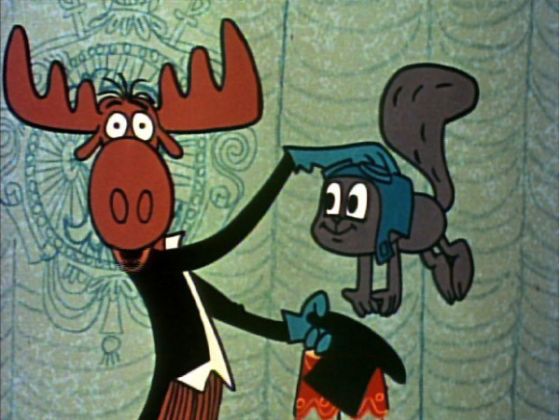
Poor Boris Badenov and Natasha Fatale. Cast as the supporting antagonists of stars Rocky and Bullwinkle, the duo never got a chance to spread their acting wings and show their stuff outside of their iconic roles. In fact, many people think Boris and Natasha were actually Pottsylvanian spies and lovers. Neither could be further from the truth.

A little  background.

Boris 
Boris Badenov was born in Russia, the product of an illicit liaison between an American father and a Russian mother. 
Ancestry.com will confirm: Gomez + short Unknown
Russian Woman = Boris Badenov
His father, one Gomez Addams, had a one night stand with an unknown Russian woman after an exceptionally nasty argument with his wife, Morticia, while on a Russian holiday. Gomez, when advised of his son, left him in the hands of an old friend, Mr. Big, a shady Russian character. 


Natasha
Natasha Fatale's birthplace was unknown, but we do know she was the product of one Morticia Addams and one Fearless Leader (Morticia said it was the scar that sealed the deal). Apparently that fight with Gomez was a doozie.
It Happened One Night: Morticia + Fearless Leader = Natasha Fatale
Once Morticia popped out Natasha she resumed her life with Gomez, leaving the baby girl with her baby daddy.

Fearless Leader, ever devoted to his boss, Mr. Big, turned Natasha over to the little big man who was pleased to have 2 babies to mold as he pleased. He thought they might make good spies or accountants, but the duo, raised as brother and sister, had stars in their eyes and made their way to Hollywood.

The Big Break
Synergy!
Hollywood is a cold town. Boris and Natasha barely got by, taking small parts here and there while working as domestic help.


Truth be told, these 2 were divas
Boris was particularly crushed when he successfully auditioned for director Preston Sturges only to have his performance stolen from him by Akim Tamiroff in "The Great McGinty." Stolen!!


Natasha, too, encountered disappointment. Every time she tried out for a role, it seemed it went to Ava Gardner. 


And then came the call. Rocket J. Squirrel and Bullwinkle J. Moose were looking for a pair of actors to pay some bumbling Pottsylvania spies. Boris and Natasha nailed the audition and were cast. Moose and Squirrel agreed they were so true to life! The creator, Jay Ward, loved them so much that he used their real names and even cast father figures Mr. Big and Fearless Leader as an extra bonus. For anyone that is concerned, appropriate work visas were obtained. 


Mr. Big in a big moment
Both Fearless Leader and Mr. Big proved to be one-trick ponies and retreated to their lives back in Russia once Rocky and Bullwinkle retired. Mr. Big later resurfaced by complaining that the HBO series "Sex in the City" had stolen his identity and persona. 

Supporting Moose and Squirrel


Boris and Natasha appeared in all but 3 of Rocky and Bullwinkle's story arcs. However, they never received more than a credit of "others" or "friends"when the stars were proclaimed at the beginning of the show. Yet, they were an integral part of the Rocky and Bullwinkle show and became familiar figures to the public by virtue of popular support. Here is a compilation of some of their greatest moments:


Life After Moose and Squirrel
Like all typecast actors, Boris and Natasha yearned for different roles. The luckless Boris lost out to Danny DeVito for a role in the TV series "Taxi," 


and Natasha lost out to Jane Russell as a representative of full-figured women.


Once Rocky and Bullwinkle decided to call it quits, Boris and Natasha knew their time in the spotlight was over.

Eventually, they retired to private lives. Boris, to Santa Barbara, where he married his physical therapist and raised avocados. He lives a quiet life and is known to his neighbors as the gentleman farmer with the funny accent.

Natasha left Hollywood for Manhattan, where she met a billionaire and lives in a big golden tower. Sometimes, when he is asleep, she swears she sees Squirrel on his head.


One last note: please don't try to make too much sense of this!