Monday, October 17, 2011

I'd be evah so charmed....

Why, I'd be evah so charmed if y'all would check out mah new little sister blog, My Movie Dream Book.

In my dreams, things turn out way they are supposed to (at least I think so!).
I'm currently dreaming of:
"Gaslight"
Click HERE and see that nasty Charles Boyer get his...

Tuesday, October 11, 2011

Bewitched: Women Who Cast a Spell: Vivien Leigh, Gene Tierney and Louise Brooks

Halloween is coming soon, but I am not a real fan of the scary. I am, however, a fan of the witch.

As we all know, there are good movie witches and bad movie witches (Glinda and the Wicked Witch of the West taught us that), but by far the most fun movie witches are the sleek and seductive ones. They don't just cast a spell, they bewitch. Kim Novak, Nicole Kidman and Veronica Lake have all played witches who use their considerable powers on their real and reel audience. But there are other witches among us, those stars who, although never playing witches, seem to cast a spell whenever they appear. The feminine powers of each of these lovely enchantresses are of the highest order.


Vivien Leigh
Like a sorceress out of King Arthur's court, she looks as though she knows her way around a magic wand and crystal ball. She may have been the perfect "English Rose," but there was always a touch of the other-worldly about Vivien. Of course, the feminine wiles of her Scarlett O'Hara are legendary. In retrospect, no one could have brought such mystical allure to the role. Even when she is a proper (and no-so-proper) English lass, such as in "Waterloo Bridge" or "A Yank at Oxford," a barely concealed passion for more than the ordinary bubbles ever-so-close to the surface. 
Look into my eyes and pay the taxes on Tara!
Her later films, such as "A Streetcar Named Desire," "The Roman Spring of Mrs. Stone," and "Ship of Fools," displayed a tattered magic, but magic, nonetheless. There is no doubt in my mind that Vivien, if she were so inclined, could cast a spell any time, any place.


Gene Tierney
Described as "lynx-like," there is something utterly feline and primal about this woman. Dress her up in the best 40s fashions and she is sublime, but in furs she look positively at home.
Just look at him trying to figure out when the exact moment
he surrendered control occurred. Shall I tell him it was before we met? 
No matter what the role, it is impossible to get over her face. Sure, she is a Mad Men gal in "Laura," but do we really think that Waldo and McPherson are on the hunt for Miss Hunt because of her talent? And doesn't Mrs. Muir look like a cat who has enjoyed her cream? Sexy Rexy may think he's in charge, but I think Lucy Muir is the one who is casting the spell on the old sea dog. 
You will do my bidding, you will do my bidding, you will do my bidding.
Even as the obsessive Ellen in "Leave Her to Heaven," we forgive her because, well, she was special, wasn't she?


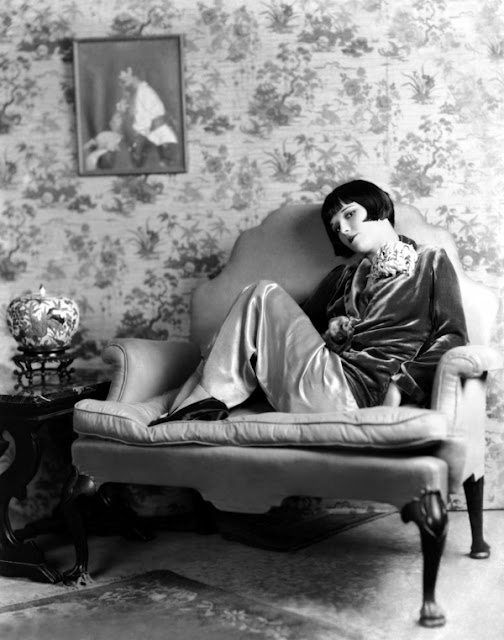
Louise Brooks
Do you really think she was unconsciously spellbinding? I think not. This is serious witchcraft at work here. The enchanting Louise has long been the subject of those who have fallen under her spell. But she is a tricky witch, as she pretends to know not the effect she has on mere mortals. She once described herself as a rich man's pet ocelot, an exotic pet to be paraded before envious onlookers. I think she was the one who held the leash.
Felines rarely look you in the eye...
unless they want to cast a spell on you.

Though her magic was potent, she wasn't much interested in cinema enchantment. Her book of spells is short, with her trio of European films ("Pandora's Box," "Diary of a Lost Girl," and "Prix de Beaute") her crowning glory. But if the magic is powerful enough, it leaps off a static photograph and continues to cast a spell. 


As we enter this autumnal season of enchantment, feel free to fall under the spell of a sleek and seductive movie witch. They may be sometimes troublesome, but they are oh so worth it, don't you think?


Catch "Dreaming of City Lights" and "Dreaming of Gaslight" over at My Movie Dream Book

Friday, October 7, 2011

Dreaming of...Rear Window

Dreaming of "Rear Window" at my new blog, My Movie Dream Book.


See you in my dreams!
Sincerely,
Lisa Carol Fremont

Thursday, October 6, 2011

Carole Lombard - Twentieth Century - What Goes Good With Ham?

This is my contribution to the Carole-tennial (Plus 3) blogathon, sponsored by Carole and Company from October 6-9. Click here to view the 4-day day all-about-Carole roll call!
Ham and Applesauce - great together!
"Since most hams are a bit salty even after soaking /scrubbing / roasting, I'd go with a couple of slightly sweet (naturally that is) dishes and at least one tart and one somewhere in the middle."  - Googled reply to the question "What goes good with ham?"
Sharing the screen with the world's biggest soaked, scrubbed and roasted ham (otherwise known as John Barrymore) is no easy feat, especially when the salty old ham rallied to the top of his main course form. But side dishes can be a great compliment to the main course, as in the case of naturally slightly sweet and tart Carole Lombard in 1934's "Twentieth Century."

Since most hams are hogs, the great JB does tend to overpower the proceedings. But little Carole, in her first great comedic role after years of thankless glamour-puss and boring leading-lady roles, takes a page from the master, asserts herself right into the center of things and gives the old boy a real run for his money. And like the old thoroughbred he is, he ups his game to the finish line.

The Story


The film, written by Ben Hecht and Charles MacArthur and directed by Howard Hawks, tells the story of Broadway producer/director/impresario Oscar "OJ" Jaffe, a Belasco-like egomaniac of epic proportions. As a sly reference to Barrymore's earlier hit, "Svengali," Oscar takes a no-talent little model named Mildred Plotka (Carole) and, through sheer will and ego, proves that he can transform a Plotka into a Lily Garland, great star of the stage. Turns out, she is a willing subject. Their association starts off well, with OJ and Lily making hit after hit, as well as love. However, as her fame and ego grows, Lily tires of OJ's possessive and domineering ways. She breaks free from him and becomes a great movie star. Meanwhile, OJ flounders without her and hits the skids. What is a megalomaniac to do?


Luckily for Oscar and the audience, he and Lily end up on the same train, the Twentieth Century Limited traveling from Chicago to New York. OJ sees this as his last chance to get into Lily's good graces and use her fame for another hit show. Mayhem and madness and mirth ensue, Oscar gets his way (through outrageous duplicity) and Lily is once again on Broadway, appearing in an Oscar Jaffe production.


Making Love and Making War
I love the chemistry between Lombard and Barrymore in this film. They make love and war with equal passion. They are both flamboyant, dramatic divas who blur the lines between heat and hate. Carole's Lily squeals, kicks, bites, claws, and coos, while JB's OJ declares his love and peddles his lies and double-dealing shenanigans with an equally grandiose sweep of the hand and piercing gaze. She's a sentimental and self-absorbed mess and he is as slippery and slimy as a gallon of snake oil. Boy, are they fun!


Favorite Scenes


Barrymore and Carole's scene where he describes how he will star her in a Broadway version of the Passion Play is hysterical. "Sand from the holy land!" She almost buys it, but not quite.


Carole telling her dull-as-dishwater boyfriend George Smith (Ralph Forbes) that she is too good for him:


George Smith: And you wanted my respect!
Lily Garland: Who cares about respect? I'm too big to be respected! The men I've known have understood that.
George Smith: Men you've known? Jaffe, you mean.
Lily Garland: Yes, Jaffe. He'll tell you what I am: a first-class passenger entitled to privileges! 
George Smith: oh, and artist!
Lily Garland: You're darn tootin' I am!


She pulls out all of the stops, but he has already left the room. All that drama and no audience!


My favorite scene is the one where Oscar pretends to be dying and connives Lily into signing a contract. He is over the top nutty, adorable, flamboyant and hysterical. It's really his scene, but Carole matches him in her overblown histrionics and utter outrage when she finds out he'll live.

Comments from Her Director and Co-Star
Howard Hawks, Carole and JB
Howard Hawks: "Marvelous girl. Crazy as a bedbug."
John Barrymore: "She is perhaps the greatest actress I ever worked with." Imagine JOHN BARRYMORE saying that!
I think Carole Lombard appreciated both sentiments!


Afterward: One Door Closing, Another Opening
While Barrymore was in the throes of his long decline, he still had a few more aces up his sleeve and this film brought out his best. Carole, on the other hand, stood on the threshold of a great career. This film proved her talent and that she was the genuine article - a star.


The Details
Twentieth Century (1934) - Columbia Pictures
Director: Howard Hawks
Producer: Howard Hawks
Writers: Charles MacArthur, Ben Hecht (Uncredited: Gene Fowler, Preston Sturges); based on an unproduced play ("Napoleon of Broadway") written by Charles Bruce Millholland
Starring: John Barrymore, Carole Lombard, Walter Connolly, Roscoe Karns, Ralph Forbes, Charles Lane, Edgar Kennedy


The supporting cast is superlative. They lend perfect comedic support and make the 2 stars shine even brighter. There is a lot of yelling in this film, which sometimes makes me edgy, but it is all done in such high spirits and fun that I am truly sorry when that train finally pulls into the station.


Tuesday, October 4, 2011

I Can't Go on With the Scene. I'm Too Happy. Mr. DeMille, Do You Mind if I Say a Few Words?

It is an honor to be nominated! It really is. I know people just say that, but really, it is!

Many thanks to the wonderful writers that make up the Classic Movie Blog Association ("CMBA"). Little FlickChick has been nominated for 3 CiMBA awards! The CiMBA is the CMBA's award for excellence in blogging, so, for this chick, it doesn't get much better.

I am nominated in the following categories:

Best Classic Movie Article:

Best Profile of a Classic Movie Performer of Filmmaker:

and
Best Classic Movie Blog Design (I feel so pretty!)

Check out the wonderful work of all of the nominees here

The other nominees are so excellent that I can't believe I made the cut. To those who nominated me, thank you so much. I'm tickled pink!

Monday, October 3, 2011

Saturday, October 1, 2011

Irene Dunne: Delightful, Delicious and No Distress

Eleventh in a series about strong women in film. Strong women are independent, beautiful, sexy, feminine and just want everything in life that a man wants and believe that they have every right to have it!


There must be something in the air these days. A year ago, Irene Dunne's name was barely mentioned. Suddenly, she seems to be everywhere and everyone is once again in love with Irene. And that is as it should be. Sometimes, the universe does get it right.


Irene Dunne was a star in an era of great women stars. She excelled in musicals, weepies and screwball comedies. She could certainly hold her own against the greatest of the era (Carole Lombard, Jean Arthur, Katharine Hepburn), but there was something slightly more mature about Irene (she was a tad older than the rest, but I'm not referring to chronological age). She could be silly, but she never seemed the Damsel in Distress. No matter what the situation, Irene always seemed to be able to handle it herself. If she let a man intervene, well, it was because she wanted it that way.
The way she talked was the single strongest impression I have to this actress - not her poise, her charm, her delivery or her warm appeal in a specific role. The tip of her tongue pressed ever so lightly behind her teeth, which automatically dimpled her cheeks and caused her to arch her eyebrows, not in any exaggerated manner but just enough to transform her whole face into the most beguiling girlish sauciness that endeared her to every member of the audience, men and women alike and children, too. One heard it even as one saw it. Laughter was invariable. One would succumb. It was inexpressibly endearing.-John Kobal, People Will Talk (1985)
This was as good a quote as I find about the very special way Irene spoke. I confess I have watched her hundreds of times and just can't figure out how she does it! But, I guess that what makes her magical and like no one else.
1936's "Show Boat" - What a cast: Irene Dunne,
Paul Robeson, Hattie McDaniel and Helen Morgan
Irene got her start in stage musicals and was brought to Hollywood after staring in a road version of Show Boat. Her debut film, 1930's "Leathernecking", wasn't much, but her next film, "Cimarron", put her on the map to stay. Irene became the queen of the "weepies," dramatic films that appealed to a female audience. She had hit after hit in such films as "Back Street", "The Silver Cord", "If I Were Free," and "The Age of Innocence". Said Irene: "Heavy dramatic roles are essential for an actress of my type. I know definitely that the status that I have achieved has been achieved through tears. So, for my career, I cry." 


With her lovely operetta-style voice, Irene always seemed to be a Jerome Kern gal. Besides her success in such musical films as "Show Boat" (her Magnolia is my favorite) and "High Wide and Handsome," Irene also famously appeared, along with Astaire and Rogers, in "Roberta." Although she sang the lovely Smoke Gets in Your Eyes, (a song that was always associated with her and played when she entered restaurants throughout her life), she was especially pleased that Kern wrote a song just for her in the movie version of the Broadway show. It was one she sang to perfection and one that described her perfectly: Lovely to Look At.


As if all of this wasn't enough, she finally dipped her dainty toes into comedy, starting with 1936's "Theodora Goes Wild", and that, as they say, was that. As the small town girl who writes a racy novel, she proved that her comedic talents were of the highest order.
One of the more civilized women. She's a dream, an absolute dream, one of the most professional women I've ever known. Nothing is instinctive, everything she does is carefully thought out, she knows every movement, every intonation, every nuance. She's a first-class crafts-woman. Her hours are like office hours, she's never late, she never slips, but instead of being dull and perfect, she's absolutely enchanting and perfect."- Douglas Fairbanks, Jr., Irene's co-star in "The Joy of Living"
Everyone, it seemed, loved Irene. It is well known that she was Cary Grant's favorite co-star. They were brilliant together in the wonderful comedies "My Favorite Wife" and "The Awful Truth," as well as in the heartbreaking drama, "Penny Serenade." Watching them together, they were perfectly complementary. Both are exceedingly clever without tremendous ego. They share, they spar and they support one another beautifully. So adult, don't you think?


One last Word - Irene in Furs


Irene never considered herself a fashion plate and allegedly did not enjoy posing for portraits, but she had a kind of effortless American elegance that always looked "just right." Irene seemed to wear an awful lot of furs in her films and, in the unenlightened age before faux, she carried if off with great aplomb. No European Glamour with a capitol "G," just good old American good taste, clean lines and Movie Star grace. 


Throughout her film career spanning from 1930 to her last film ("It Grows on Trees") in 1952, Irene Dunne displayed a vision of women as suffering, giddy, dignified, delightful and always competent and in command of their inner strength. In real life, she was married to the same man for 37 years until his death, was never part of any scandal and devoted herself to good works after her retirement from the screen. Irene Dunne was a team player (almost always the team ace, by the way), never hogging the spotlight or overshadowing her teammates. Her great gallery of performances speak of not just talent, but of wit, strength and intelligence.


Aren't as familiar with Irene Dunne as you'd like to be? These are my top baker's dozen  "Dunnies." 


1. The Awful Truth: 1937: Irene and Cary Grant at their very best (and that's saying an awful lot). Very, very funny.
2. My Favorite Wife: 1940: Irene and Cary Grant again. Again, very, very funny. 
3. Penny Serenade: 1940: The third part of the Irene Dunne/Cary Grant trifecta, only this time an emotional story of a marriage. Hankies required.
4. I Remember Mama: 1948: She's the mama that everyone wants. Touching, moving and memorable.
5. Show Boat: 1936: Irene is my favorite movie Magnolia. The film is not as good as the later MGM version, but with Irene and much of the original unforgettable cast (and an attempt to stay closer to the book's story, rather than the Broadway show book) it is memorable and precious.
6. Roberta: 1935: A beautiful film in so many ways It is light and airy as a feather and Fred Astaire and Ginger Rogers really make the movie for me, but Irene is lovely, as are the fashions.
7. Life With Father: 1947: Another lovely and very funny mother portrayal. Her pairing with William Powell is divine.
8. Back Street: 1932: The original version of this "weepie" is still the best. Irene makes it all believable and that handsome old thing, John Boles, is in it, too.
9. Theodora Goes Wild:1936: Irene's initial foray into screwball comedy and, aided by the great and underrated Melvyn Douglas, she is a pure delight.
10. Love Affair: 1939: The wonderful first version. Sorry, Cary (star of the remake, "An Affair to Remember"), but Irene and Charles Boyer are as light and sparkly as their favored pink champagne.
11. A Guy Named Joe:1943: Co-starring Spencer Tracy and Van Johnson, this is one of those wartime romances that goes straight to the heart (even though you know it's over the top). Irene, however, is wonderful and gets to sing the beautiful I'll Get By.
12. Anna and the King of Siam: 1946: NOT "The King and I," which makes it most interesting. And, it does have Rex Harrison as the king. Ever notice how Deborah Kerr inherited many of Irene's roles later on?
13. Magnificent Obsession: 1935: An unabashed sudser, and one that propelled Robert Taylor to stardom. Get out the Kleenex for this one.


The Irene Dunne film I long to see: I am ever on the lookout for 1931's "Symphony for Six Million," one Dunnie that has so far escaped me. Come on, TCM!


If you know Irene Dunne, I'm sure you adore her. If you don't know her, discover her. You'll be oh so glad you did! Promise!