A site designed for all of the wonderful people out there in the dark and dedicated to the unabashed passion for silents, early talkies, all stars and all films.
I'm all in with "La La Land." No hesitation.. almost.
Dance and romance among the stars
You love classic film? You love a charming musical score? You love charismatic stars? You love enchantment? Go see it. "La La Land" is an all out/all in movie musical, which presented me with a surprising dilemma.
"Another Day of Sun" in a typical LA traffic jam
Director Damien Chazelle has created a musical with no ifs, ands or buts. It is an homage to great musicals (and a few non-musicals) of the past (how many can you spot?) and he clearly has a "thing" for Ingrid Bergman. "La La Land" tells the timeless Hollywood story of aspiring actress Mia Dolan (Emma Stone) and struggling jazz musician Sebastian Wilder (Ryan Gosling).
Mia's adorable apartment in Hollywood, shared by fellow struggling actresses
It establishes its intent with a knock-out opening musical sequence in a Los Angeles traffic jam and never changes gears. It never looks down its nose at the genre, it never tries to mask its roots with a hip, modern attitude. Mia and Sebastian struggle and follow their dreams and we root wholeheartedly for them. So why, why did I hang back for a portion of the film?
Mia and Sebastian never leave home without their two-toned tap shoes
Why are people breaking into song or a dance in the middle of a story more acceptable (to me) when filmed over a half a century ago?
I'm all in for him!
Ryan Gosling is a revelation. His ease with the dance and the music was enchanting and he displays a real star quality that induces more than a sigh or two.
Mia looking chic for a night out on the town
Emma Stone, while not quite as comfortable with the dance, is a winsome heroine. I finally had to admit that, to paraphrase Shakespeare, the fault lies not in the stars, but in me.
Mia and Sebastian follow their dreams and their hearts
"La La Land" had to break through my own modern defenses. Why would I not immediately buy into the story of Mia and Sebastian while willingly accept Don Lockwood and Kathy Selden's romance? It wasn't them, it was me. Would I accept "Casablanca" so completely if the very same film was made today? But, "La La Land" did not let me off easy, and eventually I surrendered to the enchantment. The scene at the Griffith Observatory where the lovers dance among the stars sealed the deal. From then on, I was all in and if felt so good to be transported on the musical magic carpet ride.
Come on - kiss!
No spoilers here, but I'll just say that this love letter to Hollywood, to musicals, to star power and to romance is, for me, a winner. I think I will have to see it again because it's great to be enchanted at the movies and not in front of the TV.
La La Land in La la Land
I'm now adding Mia and Sebastian to the endless parade of movie-mad characters whose journeys to the promised land of Hollywood sometimes end in triumph and, often, heartbreak.
What is it about those films of the 1930’s that makes movie
fans all over the world open their hearts and willingly step into a unique
place and time all its own? No matter how much time passes or how the world
changes, these films continue to speak to a universal longing that spans
cultures and time.
I recently asked my friends at FlickChick’s Movie Playground
on Facebook to describe the allure of those magical films from that magical era
in 3 words or less. With their help, I offer up a little love letter to all of those
films, large and small, great and not-so great. Here we go!
Black and White
Take me away
Glamour hides hurt
Tuxes and talent
Gangsters and gold-diggers
All so elegant
Lighthearted and charming
Stories told succinctly
Stars, style, sets
Beauty and danger
You know the way
To my Heart
To my Imagination
Escape from reality
Sparkle and wit
Nick and Nora
Groucho, Chico, Harpo.
Bette and Joan
Cagney and Kay
Kate and Coop
Artisans at work
Factory made dreams
A moment in time
Forever and unchanging
Blissfully the same
You are there
Always for me
And me alone
Alone in the dark
Black and White
Beautiful to me.
Many thanks for the following for their inspiration and
participation: Tina, Antoinette, Kevin, Dee, Patricia, J. Steve, Maggie, Rosanne, Tracey, Melanie,
Darlene, Mary N, Sandra, M.A., Alicia, Mike, Christine, Susan, Ann, Stacy,
Russell, Julie, Lynn, Vince, Rosemarie, Greg, Margie, Mary M., Ellen and Tracy.
Sunny in her circus costume. Wasn't she a pretty little bareback rider?
"Sunny" started out with high hopes. It was based upon a successful Broadway show, had a score by Jerome Kern and Oscar Hammerstein and starred its original Broadway star, the great Marilyn Miller. Once sound films swept the nation, musicals and stage stars flooded the theaters.
Marilyn Miller
Marilyn Miller was one of the musical theater's greatest stars and she seemed a natural for film. She was lured to Hollywood by Warner Brothers (Jack specifically, with whom she had a cozy relationship) and paid a then astronomical figure of $100,000 to film her greatest sage hit, "Sally." It was a smash and Warners quickly planned to film another of Marilyn's stage hits, "Sunny."
Marilyn Miller in her stage consume as "Sunny." More circus and less glamour than the film version
Sadly, by the time "Sunny" was ready for release, the onslaught of musicals (specifically bad musicals) resulted in a public backlash against the genre. Too much of a bad thing set "Sunny" back and the result was a musical without hardly any music. Since the music was the whole point of the show, movie-goers were left with a "Sunny" featuring a silly and paper-thin story (British circus performer loves an engaged man, stows away on a ship to America and marries another man to gain entry and then divorces said man and gets her guy) without the music to support it. To add insult to injury, the leading man (Lawrence Gray) is a pill. Imagine if it was Fred Astaire......
Sunny waits for her Prince Charming
Still, "Sunny" has much to offer, chiefly the lovely Miss Miller. No matter how much Warners may have wanted to cut the musical numbers, it was unthinkable to put their star in a movie without several dance numbers. And this is where she shines. I offer you exhibit #1 below. When she says' "let's have some fun, you can see she really means it.
They also could not omit the show's hit number "Who?" Marilyn wasn't a great singer, but the poor quality of the sound doesn't do her any favors. Still, her star power gets her through. Here she is with the uninspiring Mr. Gray.
Personally, I found Marilyn's performance in "Sunny" even more appealing than her performance in "Sally." She comes across as quite an adorable and cheeky woman and looked lovely once she was adorned in her non-stowaway clothes. It's a shame that there was only one more film in store for Marilyn before she headed back to Broadway. I thought she had quite a nice comic touch when not trying to play the innocent. Another joy is the inclusion of Joe Donahue as the hapless fellow who Sunny marries and then divorces. Joe was the brother of Jack Donahue, a favorite stage dancing partner of Marilyn Miller. While his film career was pretty non-existent, he and Marilyn pair comfortably in "When We Get Our Divorce." Since I can't find a stand alone clip of their dance, I am posting the entire film and ask you to go to 58:17 to see this delightful pairing.
Sadly, much of the music was cut cut from the film before release in the US. The existing version of "Sunny" is pretty tattered and badly in need of preservation. A full musical version of this film that included the entire original score was released outside of the US (where they apparently had not yet tired of musicals). Oh, if only this version would surface!
Sunny dreaming of fleeing the circus and winning her man
After one more (non-musical) film, Marilyn Miller returned to Broadway in the aptly named "As Thousands Cheer." Sadly, she would die in 1936 at age 37. Still, the legacy of the darling little circus girl, Sunny, still lives on. If you happen to be in New York City at the corner of Broadway and 46th Street, look up. She is there surveying her kingdom of Broadway.
Interested in knowing more about Marilyn Miller? Check out "The Other Marilyn," by Warren G. Harris.
This is my entry in the CMBA Hollywood on Hollywood Blogathon. Click HERE to read more about films that focus on our favorite town in the world.
Hollywood Steps Out (1941)
Before I ever saw Ann Sheridan, George Raft and even Greta Garbo in a movie, I knew who they were because of the Warner Brothers Merrie Meoldies cartoon "Hollywood Steps Out."
According to Wikipedia, this 1941 $50 meal would run approximately $804 today
On a "typical" night at Ciro's, more stars than there were in heaven graced that famous watering hole. When I asked my mother "who's that?" she identified the star and their reputation as lampooned in the cartoon.
Ann Sheridan? She was known as "The Oomph Girl" because she had lots of sex appeal.
The "Oomph Girl" and Edward G. Robinson
Greta Garbo? She was a Swedish star known for her big feet. Cary Grant? He used to say "Judy, Judy, Judy."
Garbo uses her large shoes to light a match for Cary Grant. In real life, Garbo only wore a size 8 shoes.
Speaking of Garbo, I love her reaction when Harpo gives her a hot foot:
Bing Crosby? He was a singer who liked to go to the racetrack. He is the guy who hosts "The Hollywood Palace."
Crosby and his favorite pastime
George Raft? He was a tough guy actor who became famous flipping a coin.
Tough guys Cagney, Bogart and Raft share a moment
Favorites like Mickey Rooney, Judy Garland and Buster Keaton appear.
Mickey and Judy at their "Andy Hardy" best
Buster Keaton, Arthur Treacher and Boris Karloff looking as happy as possible.
Dorothy Lamour was famous for wearing a sarong and James Stewart played the shy types.
And a night at Ciro's would not be complete without these guys. I did not need my mother to identify them!
No party is complete without the Stooges
Naturally, a wolf (namely Clark Gable) is on the prowl, but his prey is not exactly who he thought "she" was!
Gable's back and Groucho's got him!
There are many more stars and even an appearance "gee"man, J. Edgar Hoover!
William Powell, Spencer Tracy, Gilbert Roland, Errol Flynn, Wallace Beery and C. Aubrey Smith admire the ladies.
Head "G" Man J. Edgar Hoover
Henry Fonda
In a way, this little cartoon was my introduction to a whole host of Hollywood stars and the mystique of Tinsel Town. It was all done with affection and admiration. Please, sit back and enjoy this little gem. I just love it!
Voices were provided by this talented trio: Kent Rogers (Cary Grant, Edward G. Robinson, James Cagney, Mickey Rooney, Lewis Stone, Ned Sparks, Bing Crosby, James Stewart, Clark Gable, Kay Kyser, J. Edgar Hoover, Henry Fonda and Groucho Marx) Mel Blanc (Jerry Colona, Peter Lorre) Sara Berner (Greta Garbo, Ann Sheridan, Paulette Goddard, Dorothy Lamour and Henry Fonda's mother)
In one of history's greatest ironies, the world's most evil man shared a distinctive mustache with a cinematic symbol of compassion, humor and humanity. Most movie stars would have shied away from the comparison, but Chaplin pursued it and, in "The Great Dictator," created one of the most courageous cinematic statements against fascism and its accompanying terror.
In the Ghetto...
While the Jewish Barber is not the Little Tramp, they share some similarities. Aside from a physical likeness, they are kindly citizens and tender of heart.
A WWI hero, the barber returns home to Tomainia with amnesia. His country is changing. He is philosophical, this gentle soul and tries to make the best of the bad situation. The country he fought for would never harm him, would it?
The barber even manages to find love in the ghetto. His scenes with Paulette Goddard are quite charming. The Tramp was no stranger to romance, and the barber is his soul mate in this respect.
Chaplin adds a barber-ballet with old Keystone buddy, Chester Conklin, and it's a nostalgic delight -no words necessary.
Meanwhile..
A mirror image in life and a negative image of the soul, Adenoid Hynkle, dictator of Tomainia, is at work on his plan to take over the world.
Adenoid Hynkle is a bigot, a bully, a braggart and a danger to civilization. When audiences see Hynkle, they know it is Hitler.
Bullies need friends, and just as Hitler needed Mussolini, Hynkle joins forces with the dictator of Bacteria, Benzino Napaloni. Napaloni, the buffoon, is played to perfection by Jack Oakie, and his scenes with Chaplin are some of the film's funniest.
The switch
And yes, the doubles are switched. Not to give to much away, but Hynkle, out of uniform and shooting ducks, is mistaken for the barber and shot. The barber is enlisted to take his place. Good replaces evil and hope is restored.
The Great Dictator, made at a time when the United States was not officially at war with Germany and before the public was fully aware of the horrors of the concentration camps, was an exercise in great courage. Hitler and Mussolini might well have been viewed as buffoons, worthy of ridicule and a chuckle. Chaplin truly put his beliefs on full display. The comedy is unforgettable, but the message is important and timeless, even more so in these perilous times:
The Great Dictator was Chaplin's first full sound film and he chose to use his voice in the most powerful way possible - with humor and deep conviction. He remained true to himself and spoke the truth and provided the world with a great film and a tale still too relevant in these times.
I can’t help it. I want to
know more about Norma Desmond’s monkey.
Monkey, we hardly knew you.....
Oh sure, we know he’s
dead, and that he serves as the plot device to get Joe Gillis into Norma’s
cage, but, really, who was he? Was he, as Joe guesses, a distant relative of
Cheetah? What was his name? Was he a movie star? Was he rescued from a circus?
How did he and Norma meet? Was he
even a “he”? After all, she did want to line the coffin in pink.
Yeah, yeah, he’s the
crystal ball into which Joe can see his future – becoming Norma’s new monkey (remember
that dream he has about the organ grinder and the monkey?). But, I’d really
like to know more about him. Did he like bananas for breakfast? Was he a clever
and urbane conversationalist? Was he able to mix Norma’s favorite cocktail? Did
he and Max get along? Did he have a smoking jacket?
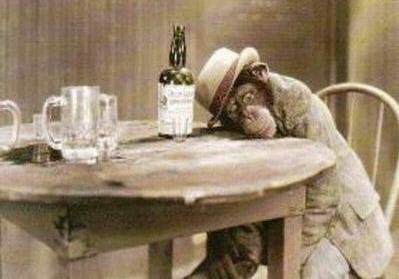
Could Monkey hold his liquor?
Like Rosencrantz and Guildenstern,
the monkey moves the plot along. But unlike those serviceable characters that
are expendable, the monkey is missed.
Did Monkey help Norma with Salome?
Imagine if he had lived! He could have
advised Joe NOT to get the vicuna. And, he might have helped Joe keep his
clandestine meetings with a little more discrete. Even better, he might have
helped Joe escape (after helping him punch up Norma’s Salome).
The New Year's Eve before the end,,,,,,,
I imagine that chimp being
quite extraordinary in all ways. Norma was a great star who had great demands
(3 husbands!) And yet, she mourned that monkey. His death left a hole in the happy little threesome that we never got to see.
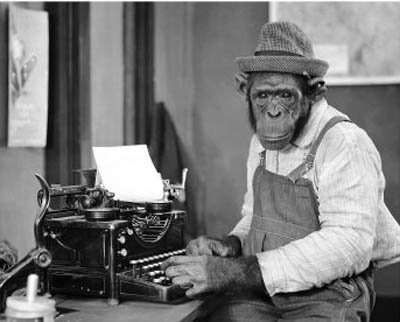
Monkey had refined table manners, which I'm sure Norma and Max appreciated
Billy Wilder reportedly kept
telling Gloria Swanson that Norma was doing the monkey, but I’m not buying it.
I picture the monkey as more of an Oscar Wilde type – witty, charming and
possibly gay. Written in the margins of Sunset Boulevard’s main story is the
story of an unnamed monkey who died in luxury but whose life remains a mystery.
Norma in her monkey fur coat. Could this have been a relative?
There I was,
blissfully enjoying “Café Society,” Woody Allen’s latest film, on its own
merits. The setting of Hollywood in the golden 1930s was a home run for me and
the characters and plot were pure Woody – whose work I always enjoy. So,
imagine the extra jolt of pleasure when
I started seeing similarities to one of my favorite films, Billy Wilder’s “The
Apartment.”
Buddy Boy and Bobby - 2 up and comers
Allen’s hero
Bobby (played by Jesse Eisenberg, an acceptable Woody-stand-in) is a young man of ambition, wanting to leave the hum-drum fate that would
surely be his by following his father’s footsteps in Brooklyn, to the glamour
of Hollywood. Lucky for him, his uncle Phil (Steve Carell, who just seems too nice) is a big shot agent. Like C.C.
Baxter, he is a young man who is eager to succeed.
Uncle Phil and Mr. Sheldrake - bosses with benefits
After some
false starts, Bobby finds a place in his Uncle’s office, but the place he
would like to be most comfortable is in the arms of his Uncle’s lovely
assistant, Vonnie. Vonnie clearly likes Bobby and the 2 become good friends.
Bobby wants more and Vonnie holds back. She has a boyfriend. And so, like CC
Baxter waiting outside the Music Man for Fran Kubelik, Bobby waits for a
romantic dinner with Vonnie. But both ladies had other plans.
I was riding
along on a single track with Woody when the breath was knocked out of me a bit
as Vonnie met in a darkened restaurant with her lover, who just happens to be
Bobby’s Uncle Phil – Vonnie’s boss and Bobby’s, too. It was the same breathless
reaction I had when Miss Kubelik meets Mr. Sheldrake for the first time. A
little shocked, a little sad.
Kristen Stewart as Vonnie steals the show. Like Shirley Maclaine, but not at all like Shirley Maclaine, she is different from the other girls, She is genuine and unique in a world of bland prettiness.
As Vonnie
keeps her double life secret, both Bobby and Phil pursue her. Unlike the cad
Sheldrake, Phil actually does leave his wife, but not before he does much soul
searching (Woody is never as cynical as Billy Wilder). In both films, an
important item sets our clueless heroes straight. For CC Baxter, a broken
compact reveals the heartbreaking truth that the girl of his dreams in having
an affair with her married boss.
For Bobby, a framed letter love letter from Rudolph
Valentino to an unnamed amour that sits on Uncle Phil’s desk provides the same
shattering realization. In the end, Vonnie chooses Phil and Bobby’s hopes are
crushed. What if Sheldrake had left
his wife for Fran? “Café Society” presents an alternate view of “The
Apartment’s” triangle, a photograph in negative.
Vonnie embraces her choice; Fran dodges a bullet
The break-up only reinforces Bobby's need to return to New York where, working with
his gangster brother, he helps run a fashionable night club. His rough edges
get polished, his confidence grows and he even marries a beautiful shiksa
goddess (whose name is also Veronica – go figure - and played by an impossibly nice Blake Lively). All is well (well, except
that the brother is executed) when, years later, Phil and Vonnie visit the café
and old memories, never far from the surface, are again stirred. It all
culminates at a New Year’s Eve party, just like in “The Apartment,” but instead
of a happy ending for the lovers, both are left with the melancholy longing for
the road not traveled.
The choices
made by the characters in both films determine the outcome. Phil chooses to
change his life for Vonnie and his decision made her chose him. Sheldrake,
tossed out by his wife, chooses Fran by default, but she chooses CC Baxter. Fran remains true to her self, while Vonnie changes (as most people do). While
Woody is more romantic than Wilder, he is also a sadder and wiser realist
operating in a sadder and wiser world. In 1960, perhaps there was hope that CC
and Fran would make a go of it and stay the same sweet kids who leave us playing gin. In 2016, we know it is most likely that Vonnie
and Bobby would not risk all for love without a gilt-edged guarantee.