Showing posts with label Pre-Code Films. Show all posts

Thursday, April 2, 2015

Pre-Code Blogathon: Call Her Savage

This is my entry in the Pre-Code Blogathon, hosted by Pre-Code.Com and Shadows and Satin. Check both sites for more audacious entries!

I used to get a real kick out of this film. It is loaded with pre-code antics up the yin-yang. But now, I can't help but view with a little sadness, too.

Don't get me wrong. "Call Her Savage" (1932) is what enforcement of the code was all about. Bestiality (implied), prostitution (almost), a dead baby, a cat fight, a gay cafe scene, lingerie and an alarming lack of said lingerie: it's all there. For those not familiar with the film, here' the story in a nutshell:

Nasa Springer (Clara Bow) is an uncontrollable wild child. we know this because she whips a snake and a (pardon the expression, but it is much in evidence here) half-breed named Moonglow (Gilbert Roland). Nasa also leaves her house without her foundation garments, frolics herself into a kind of sexual frenzy with her Great Dane and, worst of all, her papa frowns at the sight of her.

In fact, scowling pops and the beau he had planned for her are such a drag that the spirited Nasa beats it out of Texas and makes for the bright lights of Chicago. There she marries a beast of a husband, has a baby, loses the baby in a fire and almost succumbs to the streets. She fights back from the depths and manages to give ex-husband Larry Crosby (Monroe Owsley) and rival Sunny De Lane (Thelma Todd) a chair over the head and a good hair pull, respectively.
When Nasa learns that her mother is ill, she returns home to Texas. Now, be mindful that early on in the film mom seemed to have had a cozy relationship with a Native American. On her deathbed she confesses all to Nasa: the source of her wildness, her savagery is the half of her that is not (gasp!) white. Yes, mother dallied with an American Indian (old scowly-face isn't her father after all!) and Nasa is a half-breed. That explains it all! And to put the cherry on top of the cake, Nasa can now live happily ever after with Moonglow because now the races are not mixing. Yay! 

This is all pretty heady pre-code shenanigans. What makes it sad for me, and what I missed earlier, is the cruel exploitation of the brilliant Clara Bow. A great silent star whose  mental and emotional states were fragile, Clara was the victim of scandal and scurrilous rumor, innuendo and outright lies. The opening scenes are shocking, outrageous and a crass exploitation of Clara's past and reputation (rumors of sex with her dogs was one of the most cruel things said of her). It was a comfort to her to have former lover and loyal friend Gilbert Roland as a co-star. Roland remained a supportive and gentle pal to Clara for the rest of her life.

The film never really gets out of the gutter (which is one of its chief pleasures), but, in spite of this, Clara rises to the occasion and proves herself to be a fine actress. Her performance is saucy, sexy, strong and touching. Her voice is good and she is always in control of the many emotions she portrays. Monroe Owsley also turns in an interesting performance. He was an interesting actor who died much too soon.

I suppose this film can be viewed as one that strikes a blow for women's independence, since Nasa defies her father and the arranged life planned for her to strike out on her own and follow her heart, but in telling this story, the film exploits the life of the woman on the screen. Clara Bow was 27 when "Call Her Savage" was released. She made one more film and then retires. She had had enough.

"Call Her Savage" is a pre-code extravaganza that is no better than it should be, but it hurts my heart a little to watch it.


Sunday, July 15, 2012

Midnight Mary and the Mesmerizing Beauty of Loretta Young

Meet Mary Martin: Orphaned and sent away to a reformatory at 14 , hooker and gun moll at 17 and a secretary and murderess by 20. She's a good girl at heart who just has a real string of bad luck. Sounds like a juicy role for Harlow or Stanwyck, but, instead, Mary is played by Loretta Young.
Until seeing this film, I always thought of Loretta Young as the ultimate "great lady." Growing up, I saw her as the regal vision floating down a flight of stairs at the beginning of her TV show. In the movies I was most familiar with, she carried herself always as a lady above reproach. She was beautiful, but she was oh so proper; kind of an American Greer Garson. Imagine my surprise at meeting pre-code Loretta, a luscious, sexy and naughty wench.

Made in 1933, "Midnight Mary" was directed by the two-fisted William Wellman. With a running time of about 75 minutes, it plays like a slam bang Warner Brothers pre-code tale of gangsters and other low-life types, but was actually made by MGM. This gave Loretta the advantage of wearing some very swanky outfits designed by Adrian when Mary was living the high life.
Mary and Bunny: a girl has to eat
Getting ready to give it up in the back seat of a car
We first meet Mary as a woman on trial for murder. While the charges against her are read, she peruses Cosmopolitan magazine. She is a woman resigned to her fate and has not tried to defend herself. While waiting for the jury's verdict, Mary relives the journey that landed her perilously close to the gas chamber. Her memories start at age 14 when she and her friend Bunny (played by Una Merkel) are playing in the neighborhood junk yard. Sweet. Both Loretta and Una played their characters at 14 and it actually works. Mary learns of her mother's death and soon ends up in reform school (unjustly blamed for stealing, Bunny being the real culprit and a continual bad influence). As soon as Mary is sprung, the 2 pals are at it again and Mary gives it up in the back seat of a car when picked up by a stranger. From there, it is a short trip from sex for pay to a gangster's moll when she meets hood Leo Darcy, played by Ricardo Cortez. 


Darcy is nuts for Mary, but she is conflicted about her life as a moll
Mary is very conflicted by her role as live-in gal pal to Leo. He has a serious yen for her and treats her pretty well (for a thug). She tries to break free and find work, but soon ends up back in that apartment with Leo, Bunny and his cronies. It sure beats sleeping in the streets.
Mary whispers lewd suggestions while Darcy sucks her fingertips. Oh Miss Young!
Mary and Leo share a frank and sexy relationship. Mary always looks a little apprehensive (just to show us she really is a good girl), but Leo is one sexy gangster. Plus, Mary looks swell in chinchilla.

As good molls, Mary and Bunny have to assist their men in a robbery at a private gambling house. While Mary is waiting for the hold-up to start (Bunny acting as a diversion), she meets and is instantly attracted to society lawyer Tom Mannering, Jr. (Franchot Tone). Tom helps Mary escape when the cops break up the robbery. Mary sees him as a way out of her sordid life and asks Tom to help her go straight. Tom wants to talk about sex, but he sends her to secretarial school and hires her at his firm instead.
Tom rescues Mary (gorgeous in her Adrian cap and gown)
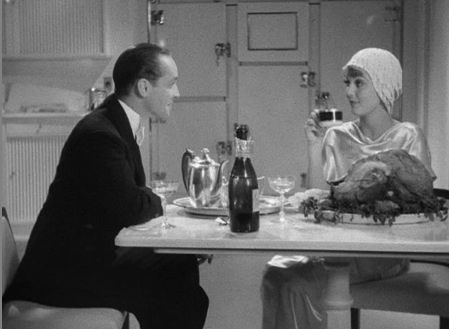
and feeds her turkey and talks of sex


Tom also serves coffee and talks of sex
Mary works hard and Tom pretends to ignore her, but before long, they are in one another's arms and planning a future. All seems rosy until one night, at a Chinese restaurant, Mary is spotted by one of the policemen who raided the gambling house. To protect Tom's reputation, Mary tells Tom she was only playing him for a fool. She then gives herself up to the law, but refuses to implicate Darcy. For that, she gets sent to prison.

Pleasure deferred: Tom pretends to ignore Mary
While in prison, Mary reads of Tom's marriage to a socialite. Once released, she tries desperately to find honest work, but succumbs to Darcy's offer of the good life once again. One night Mary and Darcy meet Tom at a nightclub. It has been made clear that Tom is unhappily married and Mary can't hide her delight to see him. Darcy spies the two and is instantly jealous. After provoking a fist fight with Tom, Darcy sends his men out to murder the lawyer. Mary follows Tom to his home to warn him. It is there that they both discover that Tom's best friend, who had taken his car, was shot and killed. Clearly, the bullet was meant for Tom.
Before the slapping and shooting, Mary tries to seduce Darcy with those big eyes
Mary returns home to Darcy and pretends that Tom means nothing to her. Darcy almost buys her act until he catches her in a lie concerning her whereabouts after the fight. Realizing the wrong man was killed, he aims to make sure Tom is plugged for good and slaps Mary around for good measure. As he prepares to leave, Mary shoots and kills Darcy in a very effective scene. The jury finds her guilty, but before the judge hands down the sentence, Tom comes forward and requests a new trial, stating that he has evidence that will clear Mary and prove that she only shot Darcy to save Tom's life. Tom then tells Mary that his wife was filed for divorce and that he knows that they will be able to put this behind them and finally be together.

Like all good and juicy pre-code films, this one is loaded with innuendo, girls in underwear and men and women who think nothing of having sex outside of marriage. When Bunny becomes pregnant, she wonders what she is going to do. She does have the baby, but we know that she considers the alternative.

Loretta Young, at age 19, is incredibly sensual and sexy. She later said that she was so naive that she had no idea she and Darcy were living together. I find that a little hard to believe. She is sexy and tough here and just mesmerizingly beautiful. I also liked Ricardo Cortez a lot and found him to be much sexier than Franchot Tone.

So, next time you see that ever-so-ladylike Miss Young floating down a staircase or across a screen, check her out pre-Hays Code and see what a hot tamale she was!


Thursday, January 27, 2011

Ann Dvorak: A Penthouse, Pre-Code and You

Second in a series about strong women in film. Strong women are independent, beautiful, sexy, feminine and just want everything in life that a man wants and believe that they have every right to have it!


Ann Dvorak was an ultra-feminine actress whose first finest hours occurred in the pre-code era of film. Unlike other strong women in film, there was nothing masculine about her. Her voice, her form, her inclinations were 100% female - not a drop of testosterone in sight. Bette Davis, and most of the other film women who are perceived as "strong" (many who will be spotlighted here in upcoming months), had masculine qualities that enabled them to stand toe to toe with men in a man's world, be it their will, determination or toughness. But not Ann. An unusual beauty, she was sleek, chic, feline and oozed femininity. She could be tough, but it was not the "in your face" grit that so many strong women have. Her toughness was all high-wire nerves. Any woman will tell you that a display of nervous ferocity will make even the strongest male cower in fear, and no one displayed frayed nerves like Ann Dvorak. She was all woman and wanted the best of a woman's world and no man was going to keep her from it! Only a script could intervene.


Two of Ann's best known roles are from the pre-code era of films made from  the late 1920s through 1934 when Hollywood let down its hair and loosened its tie, corset and tongue. It was a rough world during the Great Depression, inhabited by tough men and tougher women.

Pointing the gun at her brother,  she later
 relents and dies in his arms:
"I am you and you are me."
"Scarface" was Ann's first big break and she made an explosive impact. Playing Cesca, the sister of gangster Tony Camonte (played by Paul Muni) she is electrifying. One of the more scandalous aspects of the story is the incestuous attraction Tony has for Cesca. She allows Tony to adore her, happily accepting the money her gives her in exchange for not fooling with a casual beau. Her eyes light up with the prospect of pretty things as she happily anticipates a shopping spree. She later turns defiant and, in a nervy display of rebellion, seduces Tony's loyal right-hand man, Guino (played by a coin-flipping George Raft). Tragedy ensues, and Cesca, unable to break the bond with Tony, dies by his side, the only one loyal to him at the end. Her death scene is brilliant.While she is always edgy and emotional, she never overacts. Passionate and ferocious, Ann is never less than great and always in control.

Ann's finest pre-code moment came in 1932's "Three on a Match." If you have never seen this film, run now and find it. "Three on a Match" has it all: friendship, love, drugs, infidelity, violence and self-sacrifice. And all in 63 minutes!

Beautiful, restless and headstrong
Ann plays Vivian , a restless rich girl who, bored with husband Warren William, ditches him and her son for some excitement with bad boy gambler Lyle Talbot. Alcoholism and drug addiction (to cocaine, supplied by a really nasty Humphrey Bogart) follow, allowing Ann a wild, over-the-top finale that could only have come in Hollywood during those years. Hang in there for Ann's fabulous finish as a drug-wasted willful woman who, through her foolish, headstrong whims, has put the life of her son in jeopardy. This is the first of two films in which Ann co-starred with Bette Davis (the other being the 1934 "Housewife") and stole the show. Ann's role in this film was much flashier than Bette's, which indicates where she stood in the studio's pecking order at that time (but Bette looked very cute in a bathing suit and chemise).
Other early Ann Dvorak highlights are "The Strange Love of Molly Louvain" where she gets to sing a little of Penthouse Serenade (Ann had musical talents that were occasionally used) and "G-Men" where she gets to die in a phone booth (you just know when anyone walks into a phone booth in an early Warner Brothers film they were done for).

In 1932 she seemed ready to for super-stardom at Warner Brothers, but apparently Ann was just as willful in real life as in the movies. A marriage and her personal life took precedence over her career and, later, a legal battle with Warner Brothers over her contract (the first, before Cagney, Davis & De Havilland) put her on the back burners of non "A" films.

There were other fine performances in not so fine films, but one more moment of glory awaited - one more chance for her to wipe the floor with a bigger star. 1950's "A Life of Her Own" starred Lana Turner, but Ann, as an elegant, used-up and worn-out fashion model, stole the show in her 10 minutes or so on film. And - she gets to make another exit via a leap out of a window, bracketing her greatest early and late roles with suicides via high rise windows. When Ann is on screen, you barely know Lana is in the room, which is not surprising. If this gal could out-shine Bette Davis, what chance did poor Lana have?
Lana might look better out of clothes,
but Ann sure looked more like a fashion model in them!

Ann Dvorak - what a woman, what an actress. Once she gets under your skin, you'll never look back!

 A terrific site that is all about Ann is "Ann Dvorak: Hollywood's Forgotten Rebel."