|
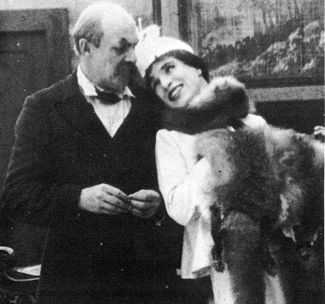
| Pola Negri & Rudolph Valentino by Federico Beltrán Masses |
Should two of the silent era's most glamorous, exotic stars have had a dignified, low-profile romance? Back in the day, running almost parallel with Garbo and Gilbert (called Gilbo or Garbert by the press -and we thought we were so witty with Brangelina and Bennifer) the hot, hot, hot Hollywood romance was Pola Negri and Rudolph Valentino (Polantino?)
Silent film stars were never portrayed as real people and were not expected to behave that way. They were the closest we ever came to the mythical gods and goddesses. Surely Hollywood of the 1920s was Mount Olympus. The movie star-gods were always magical, passionate and seemingly touched with real stardust. The studios worked overtime to promote these images and the fan magazines were filled with stories of beautiful, emotional, larger-than-life personalities. How much fun it must have been for fans to play along with this fantasy!
It is only right that these two hot house flowers of passion and romance should find one another and fall in love.
Pola Negri

Pola Negri (born Barbara Apolonia Chalupiec) was a Polish diva who, after achieving great success in Europe, was brought to Hollywood. It was Pola who showed the American gals how a sophisticated, continental femme fatale should behave, dress, and love. Pola was a fine actress and gave many wonderful performances, but her off-screen image was as interesting as her on-screen work. After arriving in America, she began a succession of affairs. One of the most famous was her brief romance with Charlie Chaplin. After the initial heat wore off, both realized they were ill-suited to one another, Pola being much to strong-willed for Charlie (who liked his women pliable). Pola took her position as a woman of glamor and passion very seriously (just as Mary Pickford protected her more virginal image with the public). She approached life, as well as art, with passionate intensity. Pola was a shameless publicity hound and a very public love affair with a willing partner was the perfect setting to display her colorful and fiery passions.
Rudolph Valentino

The greatest silent film lover, bar none, Valentino smoldered and set the hearts of American women fluttering (and the teeth of American men gnashing). Rudy, the Italian immigrant who initially spoke no English, worked at menial jobs (including dishwasher and paid escort) and found fame when he tango-ed across the screen in "The Four Horseman of the Apocalypse," was well known to have been rather unlucky in love. After his death, questions about his sexual preferences surfaced, but by all reliable accounts, the great Latin Lover loved women. His first wife, Jean Acker, who he married impulsively, was a known lesbian and their marriage never made it past the wedding night. It appears that he was passionately in love with his second wife, Natacha Rambova, an artistic set and costume designer and dancer. The beautiful Rambova's controlling nature and demands that pertained to Valentino's film career eventually lead to their split. Valentino, the great lover, was heart broken and ready for a new romance.
Rudy and Pola: The Romance
Act One: They Meet and Fall in Love
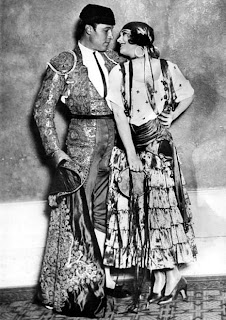 |
| Lovers meet |
Rudy and Pola allegedly first met in 1926 at a costume party thrown by Marion Davies. Rudy was dressed as the "Blood and Sand" matador and Pola came dressed as an officer-of-the-guard for Catherine the Great. Pola supposedly asked Nazimova for an introduction to Rudy. Sparks flew, an evening redezvous was made, and love was born.
Act Two: Happiness
Was it all for publicity? Perhaps a bit. Pola was more than willing to make love for the papers, but Rudy seemed a bit more reticent, although he sure did let his lady-loves lead him around by the nose (ah, a man in love!). Pola and Rudy were seen everywhere doing everything and seemed so happy. Both Pola and Rudy sport grins that are rarely seen in other candid shots. Maybe they were just so in love they wanted to share their happiness with their fans (as do all young lovers). Just take a look:
 |
| Valentino's Arabian steeds |
 |
| Attending the marriage of Mae Murray and David Mdivani |
Happily frolicking in Pola's pool and ready for an important event!
They sure seemed to make each other happy.
Act Three: Tragedy Strikes
Valentino's Death
Valentino died suddenly in 1926 while in New York. Pola, who was in Hollywood, collapsed, revived and then sped across the country to attend the New York funeral. Her grief-stricken performance at the funeral was over-the-top, even for a diva like Pola. Draped in flowing black veils (and accompanied by a secretary and press agent), Pola declared to reporters that she and Valentino were secretly engaged to be married. She posed in dramatic fashion for the reporters and then threw herself, weeping and fainting, on Valentino's open casket. Her performance caused a riot.
 |
An estimated 100,000 mourners descend upon
Frank E. Campbell's Funeral Chapel |
 |
| Grieving Pola propped up by a secretary and a publicity man |

Pola accompanied Rudy's body back to Hollywood for another funeral via train. Stopping in all major cities from New York to Hollywood, Pola willingly obliged reporters and repeated her fainting and grief routine on demand. At Valentino's Hollywood funeral, Pola ordered a $2,000 bed of red roses with the name "POLA" prominently displayed in white roses at the center of the arrangement. Her grief was on display again at the Hollywood funeral and was repeated yet again for Photoplay Magazine (who announced Pola's intention of erecting an enormous marble wedding cake to sit atop Valentino's tomb. Thankfully, this didn't happen). Oh, that Pola. She was indeed a drama queen.
Backlash and Aftermath
Pola's funeral antics, no matter how heartfelt, did not win her any fans. Her behavior was much criticized, as was her 1927 rebound marriage to Prince Serge Mdivani (so much for grief). Due, in part, to the negative press she received, her films began to fare poorly at the box office. The advent of talking pictures placed the final nail in Pola's Hollywood career. She did, however, continue to work in Europe and live a very colorful life (she was married two times, once to a count and once to a prince), finally returning to the USA in the early 1940s and remaining here until her death in 1987. She had a lot of hard luck along the way, but always behaved like the star she was. She was a fascinating woman.
In her autobiography "Memoirs of a Star" (published in 1970), Pola maintained that, despite the many men she knew and loved, Valentino was the love of her life:
My love for Valentino was the greatest love of my life. I loved him, not as one artist loves another, but as a woman loves a man.
Who knows if it would have lasted? Did they really love one another? Were they really engaged to be married? Was Valentino still in love with Natacha Rambova? Who knows if Valentino would have survived talking pictures? These unanswered questions make their romance, for me, the ultimate 1920s Hollywood Romance. Garbo seemed a bit unwilling and Gilbert seemed a bit too eager, but Polantino seemed to hugely enjoy their celebrity romance. I'm sure that tiny stars glittered about them in their happiest hours, both before the press and behind closed doors. The first flush of romance never died for them and I, for one, buy the whole story lock, stock and barrel. So joyous, so brief, so tragic, it is the stuff dreams are made of.